

Every August, the Hotter’N Hell Hundred bike ride is one of the few things that puts Wichita Falls on the national map. It transforms Wichita Falls into a national destination, bringing in millions of dollars to boost the local economy.
On this episode of the Falls Home Front, I talked with Ben Chip Filer of the Wichita Falls Bicycling Club, the executive director who keeps the whole thing moving. What he told me changed how I see local events, and most of it has nothing to do with cycling.
The Hotter’N Hell Hundred runs on volunteers, stretches across four days, and started almost by accident. I wanted the operating story straight from Ben, and what I found was a story far bigger than cycling.
Here’s a sneak peek into our conversation:
From GM Plant Floors to Running the Hotter’N Hell Hundred
I wanted this conversation because the Hotter’N Hell Hundred is one of the few things that puts Wichita Falls on the national map, and I wanted the operating story straight from the person who actually runs it. Chip is not a marketing guy who got handed a brand.
He spent more than three decades in management with General Motors and Delphi, back when the local plant was still AC Spark Plug, and he once served as assistant race director for the Greater Milwaukee triathlon. He started volunteering with this event after he moved to town in 1989, first on routes and roads, then at rest stops, and he took over as executive director on January 1, 2008.
Watch the full episode:
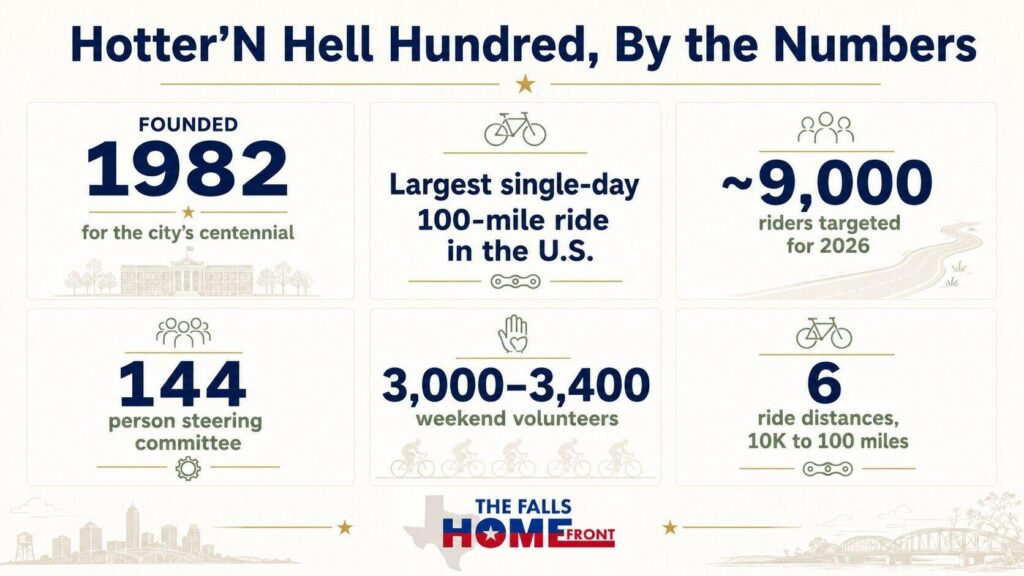
The scale is the part most people outside cycling never grasp. This is the largest single-day, 100-mile century bike ride Texas leg in the nation. Chip is targeting roughly 9,000 riders for 2026, and the operation runs on a 144-person steering committee plus more than 3,000 weekend volunteers.
Riders come from 40 of the 50 states most years, and from a handful of foreign countries, and a lot of those international riders first rode here while stationed at Sheppard Air Force Base. If you want the full picture of how Sheppard Air Force Base drives the Wichita Falls economy, I broke that down separately, and the ride is a perfect example of the ripple effect in action.
It looks like a bike race. Sit with Chip for ten minutes, and you realize it is really a story about leadership and community. You can see the full Hotter’N Hell Hundred weekend lineup on the event site, but the numbers below are the fastest way to feel the size of it.
How a Rejected Rocking-Chair Marathon Created the Hotter'N Hell Hundred
The origin is the first real lesson. In 1981, Wichita Falls leaders wanted an event to celebrate the city’s 1982 centennial, so they brought in consultants from out of state. The pitch those experts delivered was a rocking-chair marathon. The committee looked at each other and decided that was not the spirit of this town. Founder Roby Christie, a member of the Wichita Falls Bicycling Club, countered with something that actually fit the place: a 100-mile ride, in 100-degree August heat, to mark 100 years.
The event’s name originated from a joke about the heat deterring attendance. Initial resistance from local churches faded as the event grew, attracting over 1,200 riders in its first year, surpassing the expected 500. Organizers ran out of bib numbers and used paper plates for numbering instead. It was supposed to be a one-time thing.
When Christie asked what they were doing the next year, the answer was basically a shrug, and the ride simply continued. More than four decades later, the event’s full origin story still anchors everything, and the 2026 ride runs from August 27 to 30.
Here is what stayed with me: authenticity wins. The event worked because it reflected who Wichita Falls actually is, not a borrowed idea from a consultant’s slide deck. That is not a cycling lesson; it is a marketing lesson, and the research backs it up. University extension work on the economic and social payoff of community festivals shows the biggest returns come from events that put local people, suppliers, and identity at the center. Wichita Falls did that 44 years ago without a study to tell them to.
What 144 Steering Committee Members and 3,000 Volunteers Taught Me About Delegation
The operations lesson for real estate agents and small-business owners focuses on a steering committee of 144 people. This committee is divided into teams of at least two, each with its own responsibilities. Meetings begin at the end of April and continue through event week. Additionally, 3,000 to 3,400 weekend volunteers receive t-shirts, which also serve as a headcount system.
The rest-stop model is innovative, with Saturday volunteers managing stops run by community groups and nonprofits. Leftover funds are returned to these groups, showcasing an economic benefit. The point that hit me is this: Ben Chip Filer, who runs the Wichita Falls Bicycling Club, does not run this alone. He built a structure where ownership is spread out, and every single role has a clear owner. That is the whole game.
Whether you are building a team, a brokerage, or a volunteer crew, clarity plus shared ownership scales further than control ever will, and it is the same instinct I lean on when I think about what makes the Wichita Falls area worth putting down roots in. A place, like an event, is only as strong as the people who show up for it.
“We have probably the best group of volunteers on the Hotter’N Hell steering committee. We’re now at a hundred and forty-four people on the steering committee. Everybody on the steering committee is part of a team of at least two that has a specific responsibility that they work on through the year and then through Hotter’N Hell week. We hand out somewhere between three thousand and thirty-four hundred volunteer t-shirts, and that’s for everybody who volunteers, whether it’s at a rest stop, in registration rooms, in cleanup, or in setup. Everybody who volunteers gets a t-shirt, and that helps us keep an idea of how many people we have volunteering.”
That delegation discipline is also what makes the economics work, because a volunteer engine this high keeps costs down and sends real money back into town. There is solid evidence behind the measurable economic impact of bike tourism, and Wichita Falls lives it for one week every year.
The Hotter'N Hell Hundred Economic Impact Hiding Inside a Bike Ride
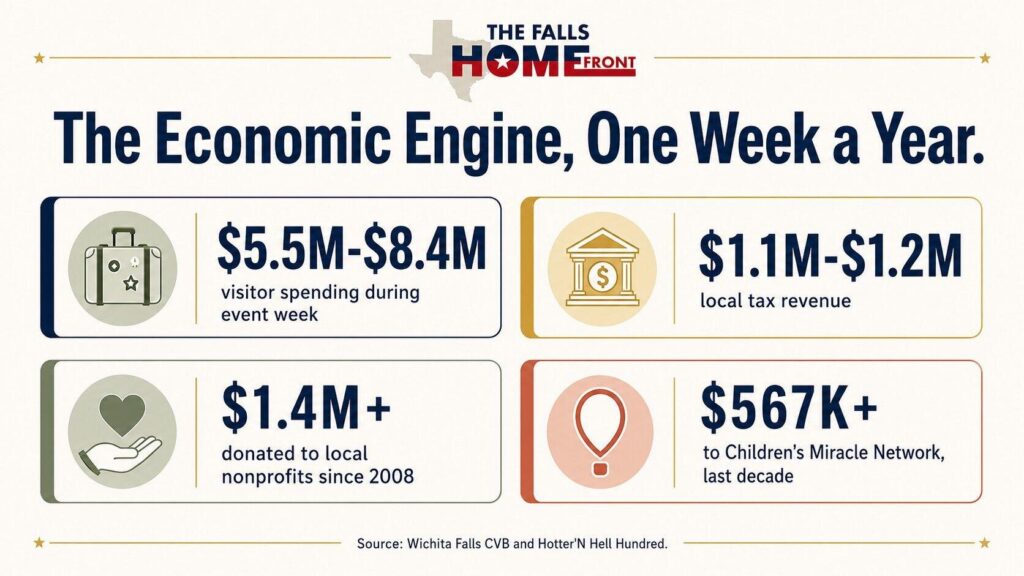
According to the Wichita Falls Convention and Visitors Bureau, the event drives an estimated $5.5 million to $8.4 million in local spending during event week, plus another $1.1 million to $1.2 million in local tax revenue. More recent estimates from city and Chamber officials run higher in some years, which tells you the Hotter’N Hell Hundred economic impact number we usually quote is on the conservative side. This is money that comes into town, gets spent, and then circulates through the economy a few more times.
The giving-back side is just as striking. Since Ben Filer of the Wichita Falls Bicycling Club took over in 2008, the event has donated more than $1.4 million to local nonprofits, including more than $567,000 to Children’s Miracle Network in the last decade alone. The event channels its proceeds back into local nonprofits through the same community groups that staff it, which closes a loop most events never even attempt.
Why does this matter to a Realtor specifically? Because a healthy local economy and a strong community identity are not abstractions to me. They show up in how people feel about living here, and that feeling is the market I work in every single day. Events like this fill hotels, feed restaurants, and fund nonprofits. That is community building with a balance sheet attached, and it is one more reason I stay optimistic about where the Wichita Falls housing market is heading in 2026. A town that can rally 3,000 volunteers and pull in millions every August is not a town in trouble.
Why Constant Reinvention Keeps the Hotter'N Hell Hundred From Fading
Chip framed the survival story on two fronts: the product and the funding. The product evolved as cyclists evolved. What began as a single Saturday endurance ride is now a four-day Wichita Falls cycling event.
The consumer show starts Thursday, with mountain bike races and evening criteriums on Friday. Saturday features endurance rides from 10K to 100 miles, a night Gravel Grind of 27 or 42 miles, and Sunday wraps up with a trail half-marathon and a 10K.
The Triple Threat and Quadzilla invite 150 riders to tackle all four events. Gravel riding is gaining popularity for its safety, with less car traffic, and Chip suggests group rides and lights for safety. That tracks with federal guidance on staying visible to drivers and riding defensively, where being seen is the single biggest factor in staying safe.
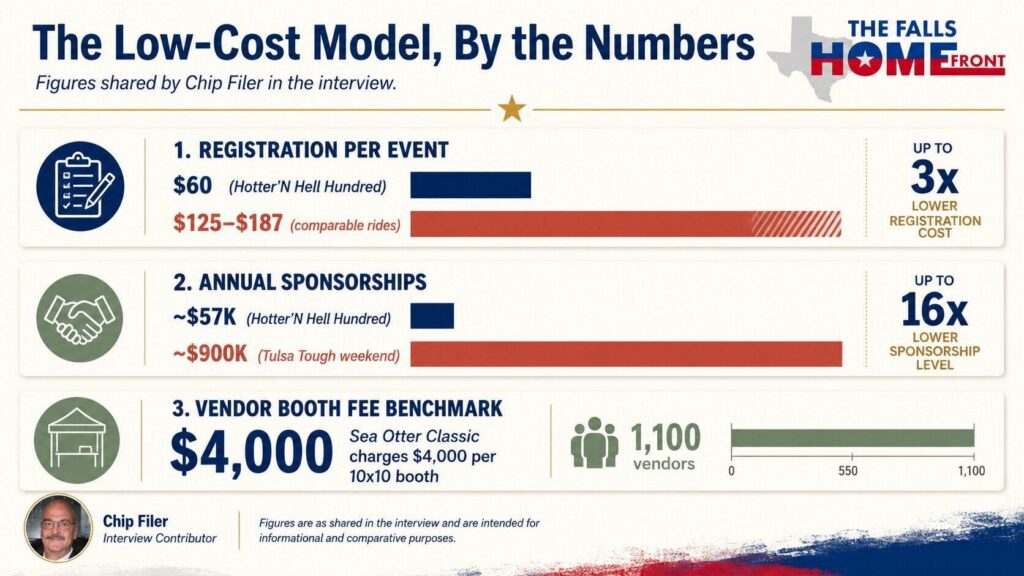
The funding pivot is the sharpest lesson for any business owner. Registration is held at $60 per event, deliberately low against the $125 to $187 that comparable rides charge. To cover rising costs, Ben Filer at the Wichita Falls Bicycling Club is leaning into the two other revenue sources the big rides use, sponsorships and vendor fees, and he studies his peers directly. He visited Tulsa Tough and the Sea Otter Classic to learn how they do it, and the numbers he came back with are humbling.
“We took a look at it and said, well, where else can you draw from to be able to afford to put the ride on? And the two other sources that the big rides do, if you go to Tulsa Tough, they have registrations of about twenty-five hundred, yet they put on a full weekend of racing. They do it through sponsorships, through community sponsorships, and they get some amazing sponsorships. I think last year was a normal year in sponsorships, and we had about fifty-seven thousand dollars in sponsorships. If you go up to Tulsa Tough, their weekend sponsorship is nine hundred thousand dollars. That’s their budget, and they make it every year.”
The takeaway for me is that reinvention is not a one-time project; it is the operating mode. Keep the core accessible, watch your audience, and diversify how you fund the thing before you are forced to. The chart below shows just how lean this model runs next to its peers.
Why I Now Treat Local Events as a Real Estate Advantage
The biggest mindset shift Chip gave me is stewardship over ownership. The Bicycling Club runs the event, but it belongs to the community, and that is exactly why it cannot be sold or moved. An outside group once tried to buy it and take it to the Metroplex, and the answer was no, because moving it would kill the very thing that makes it work.
It changed my view on work. Community events are vital. As a Realtor, Wichita Falls’ health is my product. Chip also shifted my view on modernization. Hoegger Communications made the event’s website mobile-friendly. Now, I focus on engaging the community, defining roles, reinvesting locally, and modernizing. Those principles travel from a bike race straight into how I run my business, and they are the same reason I keep a close eye on the local events worth planning your year around here in North Texas.
“It does belong to the community. We had an organization, it was actually before I took over, that came up and asked Roby if they could buy the event. And he said, no, you can’t buy the event, because you can’t move it from here. They wanted to take it to the Metroplex, and he said it just wouldn’t work, because it belongs to the community. It does not belong to the Wichita Falls Bicycling Club. It belongs to the community.”
That single idea, that the best North Texas community events are owned by the people who show up for them, is something every business and every neighborhood here can learn from.
If these are the kinds of community and market dynamics you’re interested in, I regularly share updates from the Wichita Falls area on my Instagram and LinkedIn profiles—including real estate data, local event coverage, and insights I don’t always fit into the podcast.
Want to hear my full conversation with Chip Filer and dive even deeper into how a volunteer-run bike ride became a community engine for Wichita Falls? Listen to the complete podcast episode on Falls Home Front.
Listen Here


Frequently Asked Questions About the Hotter'N Hell Hundred
When is the Hotter’N Hell Hundred, and how do I register?
The date moves every year because it always lands nine days before Labor Day, which puts it somewhere between August 22 and August 29. The 2026 weekend runs from August 27 to 30 in Wichita Falls. You can register for the distance you want to ride on the official event site. Chip keeps the price low on purpose, at $60 per event, well under the $125 to $187 that comparable rides charge.
Do I need to be an experienced cyclist to take part?
The Saturday rides range from a 10K family route to 100 miles, with 25, 50, 75, and 100K options. Chip advises: train for the distance you plan to ride. Cycling is gentle on the body, which keeps riders engaged for years. Chip himself rides with two artificial knees, and the science agrees that cycling stays gentle on aging joints while still building real fitness.
How can I get involved if I do not want to ride?
Volunteer or watch. Join rest stops, registration, or cleanup crews, or enjoy the free Friday-evening criterium races, Finish Line Village, and consumer show. It’s a rare weekend when the whole town gathers.
Who is Tim Lockhart, and what makes him qualified to help?
Tim Lockhart is a retired U.S. Air Force Major and Certified Military Relocation Professional (MRP) who spent his final assignment as Director of Operations at the 366th Training Squadron at Sheppard AFB. Since 2012 he’s helped 300+ families buy and sell around Wichita Falls — many PCSing in or out of Sheppard AFB — using VA loans, BAH-aware budgeting, and remote-friendly tools for tight PCS timelines. See how Tim helps military families relocate to Wichita Falls →
Apply as a Guest on the Falls Home Front Podcast
Wichita Falls runs on the people who show up, the business owners, the volunteers, and the leaders who build something and then hand it to the community. If you are working in North Texas real estate, business, or local life, and you are solving real problems or building something worth talking about, I want to hear your story on the Falls Home Front.
Disclaimer: This podcast is for informational purposes only. Tim Lockhart is a licensed REALTOR® in Texas. Community insights shared here do not constitute specific real estate, investment, or financial advice. Consult licensed professionals regarding your individual situation.
About Tim Lockhart
Tim Lockhart is a Wichita Falls Sheppard AFB PCS Home Selling & Exit Strategy Specialist for military homeowners. He works with active duty personnel preparing for PCS moves to help them determine the right strategy for their home—whether to sell, hold, or adjust timing—before executing the plan. Tim is a REALTOR® with Keller Williams Wichita Falls and a RamseyTrusted real estate agent. He is a retired U.S. Air Force officer with over a decade of experience helping clients navigate complex, time-sensitive real estate decisions in Wichita Falls, Burkburnett, and Iowa Park. If you have PCS orders and need a clear plan for your home, schedule a consultation to map out your next step.- Will Clark of Clark Design Studio Reveals the One Design Choice That Saves Wichita Falls Homeowners Thousands - September 8, 2026
- How Gaby Lockhart of Barrett Financial Group Turns a Lender’s No Into a Yes for Wichita Falls Buyers - September 3, 2026
- Should Military Families Hold Real Estate as an Investment Instead of Selling It? - August 27, 2026
- What Ian McMurtrie and Rita Beemen of Raconteur Press Taught Me About Owning Your Own Story - August 26, 2026
- Is a VA Loan Really Weaker Than a Conventional Offer for Wichita Falls Sellers? - August 24, 2026
- What Do July 2026’s Wichita Falls Housing Numbers Mean for Home Sellers Near Sheppard AFB? - August 20, 2026
- Stephen Barton of Core Community Mortgage on Why Waiting Costs You More Than Failing - August 19, 2026
- What Happens If You Price Your Home Too High Before a PCS Move From Sheppard AFB? - August 17, 2026
- John Culbertson Reveals What Every Texas Homeowner Facing Foreclosure Should Know - August 10, 2026
- Selling an Inherited Home in Wichita Falls? Here’s What You Need to Know - August 7, 2026