

When you invest in a bottle from a local boutique winery, you are not just buying wine. You are buying into the economic identity of your own backyard.
That idea sat at the center of my recent talk with James Hanger of OG Cellars on The Falls Home Front. We unpacked premium winemaking, hidden North Texas history, and the kind of commercial real estate move that can reshape a neighborhood.
Catch the preview of our conversation:
As someone focused on this city’s future and local enterprise, boosting economic growth, I view James as a model for Wichita Falls’ potential. What follows are the lessons that stood out most for the people building our regional economy.
Listen to the full episode:
Why I Wanted James Hanger and OG Cellars on the Show
My mission with this show has always been to spotlight the people quietly building the culture and commerce of our region. Our local economy does not run on corporate expansion alone. It runs on boutique hospitality, regional flavor, and plain entrepreneurial grit. That is exactly why I see so much overlap between great winemaking and the work of local businesses that shape Wichita Falls community growth.
When I looked at what James was building, from his family ranch in Sunset to his new home in Century Plaza, I knew I had to get him on the mic. He has taken an old craft and turned it into an engine for community pride. For agents, investors, and entrepreneurs, watching how an owner like James scales a footprint and anchors a corner tells you exactly where a market is heading.
Reading those signals is the heart of planning for future growth, because every new tasting room, retail corridor, and infrastructure upgrade tells us how our city is maturing.
You can explore that pattern further in my notes on Wichita Falls growth and community development.
Moving Beyond Mass Production: The Artisan Winemaking Process
One of the most eye-opening parts of our conversation was the gap between mass-produced commercial wine and a true boutique operation. High-volume production leans on heavy chemical use, stabilizers, and aggressive filtering to force consistency. James walks a different road. He leans on old-world craftsmanship and lets the regional terroir speak.
The artisan Texas winemaking techniques behind OG Cellars start with a short ingredient list. He uses 100% Texas-grown grapes, select yeasts, and basic nutrients, and that is largely it. As James put it, he avoids harsh chemicals and animal byproducts that often slip into a mass production line out of sheer necessity. For a deeper look at how terroir and grafting shape a wine’s character, the Texas A&M AgriLife research on wine science is a great resource.
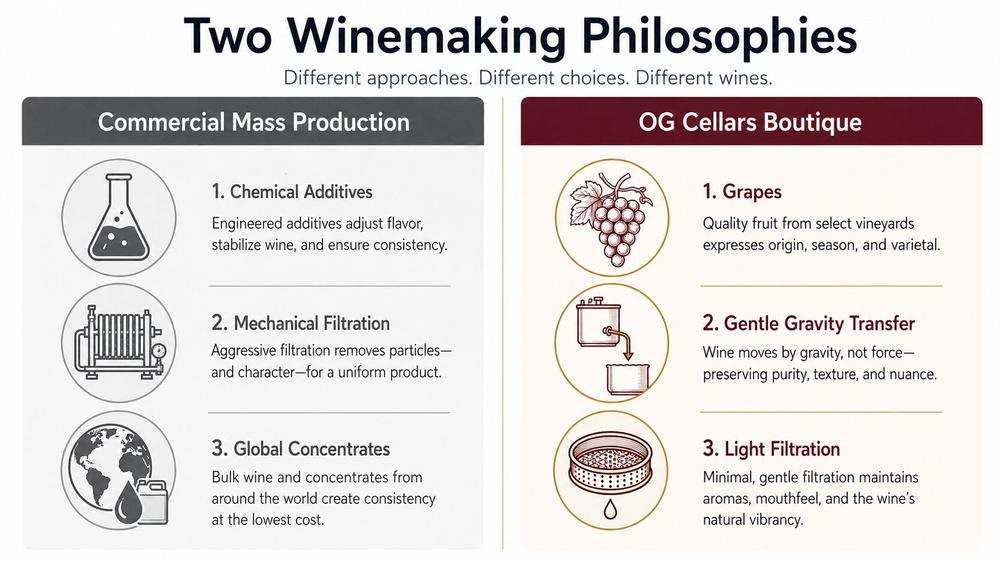
Natural Clarification vs. Industrial Filtration
To clear his wine without stripping its body, James relies on a physical method called racking. He moves the liquid gently from one vessel to another over time, leaving the cloudy sediment, known as lees, behind at the bottom. Do it too aggressively and you stir everything back up, locking in a permanent haze that only heavy filtration can fix.
Winemaking Phase | Industrial Mass-Production Approach | OG Cellars Boutique Approach |
Clarification | Heavy chemical fining agents and additives | Natural racking, gentle gravity-based transfers |
Filtration | Aggressive, multi-stage mechanical stripping | Minimal, light filtration that retains flavor and mouthfeel |
Ingredient Sourcing | Bulk commercial concentrates from global regions | 100% Texas-grown grapes reflecting regional terroir |
Embracing Gravity Flow Over Heavy Mechanical Pumping
A core hallmark of the OG Cellars style is the near-total ban on mechanical pumps. James walked me through why oxygen is the real enemy and how standard pumping forces unwanted air and turbulence into the liquid, dulling delicate notes fast. Instead, he recreates the hillside gravity systems of classic European estates by raising tanks up to 15 feet with a forklift so the wine flows down naturally during bottling.
“The gentler you are on the wine, the better the wine will be, because you’re adding less oxygen to it, and oxygen is a wine’s enemy. Oxygen is what will turn your wine into vinegar over time. So the least amount of exposure to oxygen you can have, the better the wine will be. So when you’re moving wine from one vessel to another, you have choices. If you have enough, high enough place where you can have it up high, and gravity flow it down to low, that’s pretty much ideal. It’s slower, but it’s still better for the wine. Another way you could do it is using inert gas like argon, where I have a tool where I can pump argon into a barrel. And then a third way I could do it is using a pump. Now, a pump is gonna use basically like a vacuum, and so there’s gonna be air involved. That’s gonna be the harsher way of doing things. So we try not to do pumps at all. I have forklifts so that I can lift things up high and gravity flow them down. Even when we’re doing our bottling, I lift the tank, and I’ll put it 15 feet up in the air, and we’ll bottle using gravity flow into our bottling line. It’s just easier on the wine than having to pump it. It takes longer. It’d be much quicker if I used pumps. But I guess the proof is in the pudding.”
That patience is the whole point. The slower process costs him time but protects the finish, and you can taste the difference. James’s early profile in the Texas wine community coverage of his winemaking journey shows how long he has championed this hands-on approach.
Debunking the Myths of Sulfites and Flavor Infusions
There is a lot of misinformation floating around about how wine gets its taste and what causes those next-day headaches. James directly debunked the idea that quality wines are secretly injected with flavor extracts. At OG Cellars, every fruit note comes naturally from the grape skins and specific yeast strains, while the rich caramelized tones come strictly from long oak barrel aging. He even won over a self-described whiskey-only customer with a wine aged seven years in oak.
He also cleared up the sulfite scare that someone planted in the public mind decades ago. Sulfites are a natural byproduct of fermentation, and they show up in far higher concentrations in canned groceries and white wines than in dry reds. Because red wines ferment on the skins, they gain natural protection and need fewer added sulfites than whites. For most people who think reds bother them, James suspects the real culprit is tannins, not sulfites.

The Hidden History of North Texas Viticulture
I was fascinated to learn how deep North Texas roots run in the global wine story. James told me about T.V. Munson, a grape grower and scientist out of Denison, Texas. When the phylloxera epidemic was wiping out the French wine industry in the late 1800s, Munson discovered that native Texas rootstocks resisted the pest. He sealed thousands of cuttings in wax, shipped them across the Atlantic, and saved France’s vineyards through grafting.
“You gotta think about this is the late 1880s, that word got to a grape grower in Denison, Texas. You’re thinking telegram. Got word to this man in North Texas that the French were losing their wine industry, and somebody had given him enough information that he was able to say, ‘I know what that phylloxera bug is, and I have a rootstock that is resistant to it.’ And then he went out to his own vineyard and took thousands of cuttings from his vine, had to basically dip them in hot candle wax to seal each end, so that the vine would go dormant without drying out and dying. Put them on a covered wagon, take them to the DFW area, put them on a train from there to Galveston, and then have those steamed for months across the Gulf and the Atlantic to get over to France, and for someone over there to believe that a guy from a town in Texas that they had never heard of knew what he was talking about. Well, he did. And it saved their entire wine industry. So I like to tease people from France and say, ‘You know, we saved your butt three times.’ The wine industry, as well as two world wars. You can’t have a French wine without having a little bit of Texas in it because all those rootstocks that were saved from that are what saved those vineyards.”
That story is well documented. France later honored Munson as a Chevalier du Mérite Agricole, and historians credit his disease-resistant rootstock with saving the French wine industry from phylloxera. Today, that same resilient spirit fuels a booming Texas wine scene, and the surge in North Texas wineries is the clearest proof.
Our climate mirrors the dry interior of Spain and Italy, which makes North Texas prime ground for heat-tolerant varietals like Tempranillo and Syrah.
How a Commercial Real Estate Pivot Reshaped the Move to Century Plaza
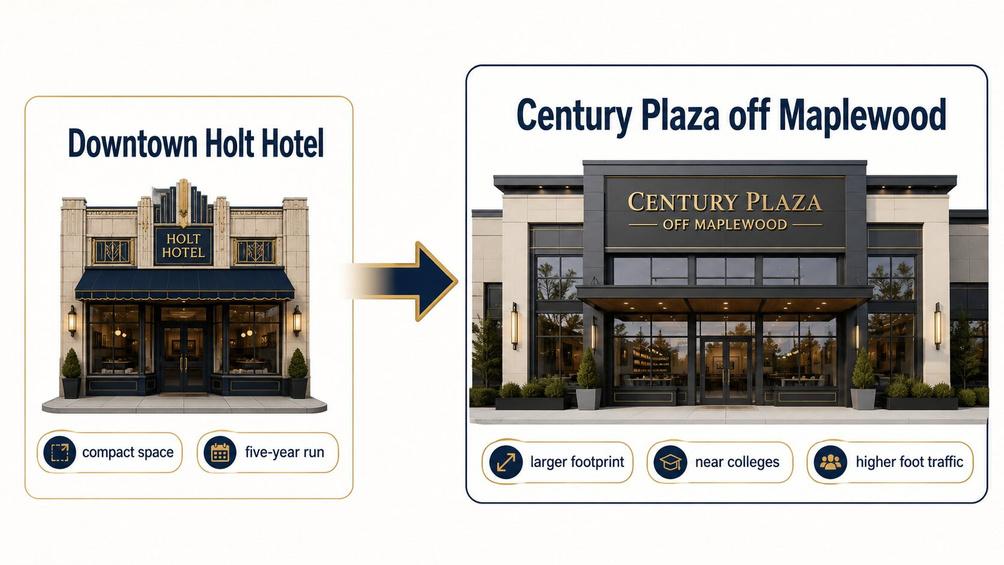
From a business and real estate angle, James shared an invaluable lesson about adaptability that doubles as a smart boutique winery business strategy. OG Cellars ran a beautiful art deco tasting room in downtown Wichita Falls for five years inside the historic Holt Hotel building, a space chronicled in this local coverage of the OG Cellars second location. But the foot traffic and synergy never scaled the way he needed.
Rather than wait on hypothetical development, James made the executive call to pivot. He relocated the tasting room to the new OG Cellars Century Plaza space off Maplewood, planted between Midwestern State and Vernon College and near major retail development. The bet paid off fast, with more traffic, a larger footprint, and a Spanish-inspired tapas menu built for shared experiences.
“We loved our space downtown. Don’t get me wrong. That Art Deco vibe that we had from being in the Holt Hotel building was awesome. We loved it. We carried it all over into this new space as well. We gave downtown five years, and it just wasn’t there yet. As a business owner, I had to do what’s right for my business, and that’s why. This new place is much bigger and a lot more space, a lot more people, and just a lot more ambiance is what I would say. You walk in the door, and you think it’s gonna be a tiny little shop, and then it opens up, and you’re like, ‘Whoa, this place is huge.’ But it’s just the growth since post-COVID of people saying, ‘I don’t wanna live in the metroplex anymore. I don’t want to deal with traffic. I want a slower pace, but I still want a lot of the conveniences of the bigger city.’ We felt that being in the new location over Maplewood positioned us better to help do that more.”
That is a textbook location strategy, and it mirrors what I see across our market every week. Owners who read demographic shifts early and reposition near the heart of consumer spending win.
James essentially bet on the city’s infrastructure roadmap and the Wichita Falls commercial growth taking shape near the colleges, the hotels, and the mall redevelopment before those projects fully arrive. That is the same forward read on city planning and economic development that separates reactive operators from the ones who help shape a corridor.
It is the same logic behind smart real estate technology solutions for Wichita Falls businesses that help operators track where the growth is actually moving.
How This Conversation Reshaped My View of the Local Business Frontier
Sitting down with James shifted how I see the cultural maturation of our region. For years, outsiders dismissed Texas wine as cheap, sweet, bottom-shelf jug wine. Then James went toe to toe with elite California and international makers and took home gold at competitive San Francisco blind tastings. One of his Tempranillos earned gold in a field where only ten golds were awarded, and seven went to Spanish producers. That proves North Texas can make a world-class product.
The numbers back the momentum. The Texas wine industry now contributes more than twenty-four billion dollars in economic impact to the state, ranking second nationally behind California. Our community of over 100,000 people keeps drawing families out of the congested metroplex in search of a balanced lifestyle.
My vision for Wichita Falls is smart growth, improved infrastructure, and thriving local businesses, making it a deliberate choice for residents. Supporting local brands is key to economic development.
When we back distinct local brands, we are investing in the commercial vitality and cultural backbone of North Texas. You can taste that vision firsthand by exploring the OG Cellars wines and tasting experience or visiting the winery directly at ogcellars.com.
Want to hear my entire conversation with James Hanger about his journey from hobbyist winemaker to building OG Cellars and reshaping North Texas wine culture? Listen to the full podcast episode now!
Listen Here


Frequently Asked Questions About Texas Wine and OG Cellars
What makes North Texas a viable region for growing high-quality wine grapes?
North Texas offers a long, hot growing season with strong heat units that match the interior Mediterranean climates of southern Europe. By planting thick-skinned, heat-tolerant varietals from Spain, Italy, and southern France, such as Tempranillo and Syrah, local growers harvest complex, balanced fruit. Thinner-skinned grapes like Pinot Noir and Chardonnay struggle here because they dislike the heat.
Where are the OG Cellars tasting rooms located, and what are their hours?
The main production winery and wood-fired pizzeria sit on the family ranch in Sunset, Texas. The expanded urban tasting room and tapas bar is in Century Plaza in Wichita Falls. The Century Plaza location opens Tuesday through Saturday at 4:00 PM, staying open until 9:00 PM on weeknights and until 11:00 PM on Friday and Saturday.
What weekly community events does OG Cellars host?
The Century Plaza location runs an active weekly schedule. Tuesday nights feature charity bingo, which raised roughly $15,000 last year for local nonprofits. Wednesday nights offer ladies’ night with 10% off drinks, food, and pop-up boutique shopping. Thursday nights bring an all-night happy hour with $3 off all glasses of wine, followed by live music and karaoke on the weekends.
Who is Tim Lockhart, and what makes him qualified to help?
Tim Lockhart is a retired U.S. Air Force Major and Certified Military Relocation Professional (MRP) who spent his final assignment as Director of Operations at the 366th Training Squadron at Sheppard AFB. Since 2012 he’s helped 300+ families buy and sell around Wichita Falls — many PCSing in or out of Sheppard AFB — using VA loans, BAH-aware budgeting, and remote-friendly tools for tight PCS timelines. See how Tim helps military families relocate to Wichita Falls →
Apply as a Guest Speaker
The North Texas business landscape is moving fast. Capital is shifting, commercial corridors are expanding, and local craftsmanship is redefining our regional identity on a national stage.
The decisions we make now about infrastructure, growth, and which local visionaries we get behind will define the city we hand to the next generation.
If you are an entrepreneur, real estate professional, or industry expert building something lasting in our community, I want to feature your story. Whether your expertise is development, boutique hospitality, finance, or local trade, your insights can help shape the future of our market.
Disclaimer: This podcast is for informational purposes only. Tim Lockhart is a licensed Texas REALTOR® and can help with your real estate questions. However, this content does not constitute legal or financial advice. Consult appropriate professionals regarding your specific situation.
About Tim Lockhart
Tim Lockhart is a Wichita Falls Sheppard AFB PCS Home Selling & Exit Strategy Specialist for military homeowners. He works with active duty personnel preparing for PCS moves to help them determine the right strategy for their home—whether to sell, hold, or adjust timing—before executing the plan. Tim is a REALTOR® with Keller Williams Wichita Falls and a RamseyTrusted real estate agent. He is a retired U.S. Air Force officer with over a decade of experience helping clients navigate complex, time-sensitive real estate decisions in Wichita Falls, Burkburnett, and Iowa Park. If you have PCS orders and need a clear plan for your home, schedule a consultation to map out your next step.- How a Pink-Stained Rental Disaster Led David Edwards of CoLiving Operations to a $2,000-a-Month Housing Model - October 20, 2026
- Why JC San Pedro of Amplify Credit Union Warns Buyers Not to Spend Their Full Pre-Approval - October 5, 2026
- What Is Really Happening in the Wichita Falls Housing Market This Fall? - October 2, 2026
- Why Smokey Garrett of The GO Network Believes AI Will Make Great Agents Impossible to Replace - September 28, 2026
- Why Did a Wichita Falls REALTOR® Step Up as a Founding KW Military Ambassador in Texas? - September 24, 2026
- Kelly Thompson of Shearman Roofing and Construction Explains Why the Best Roofers Slow Down First - September 22, 2026
- Lawrence Courtien of Buffalo Property Inspections on the Inspection Mistake That Costs Buyers Thousands - September 14, 2026
- Will Clark of Clark Design Studio Reveals the One Design Choice That Saves Wichita Falls Homeowners Thousands - September 8, 2026
- How Gaby Lockhart of Barrett Financial Group Turns a Lender’s No Into a Yes for Wichita Falls Buyers - September 3, 2026
- Should Military Families Hold Real Estate as an Investment Instead of Selling It? - August 27, 2026