
What if a missed 30-minute window cost you the house you wanted?
Most homebuyers lose their dream house over a single missed phone call. But what if the fix isn’t luck; it’s a bias towards action?
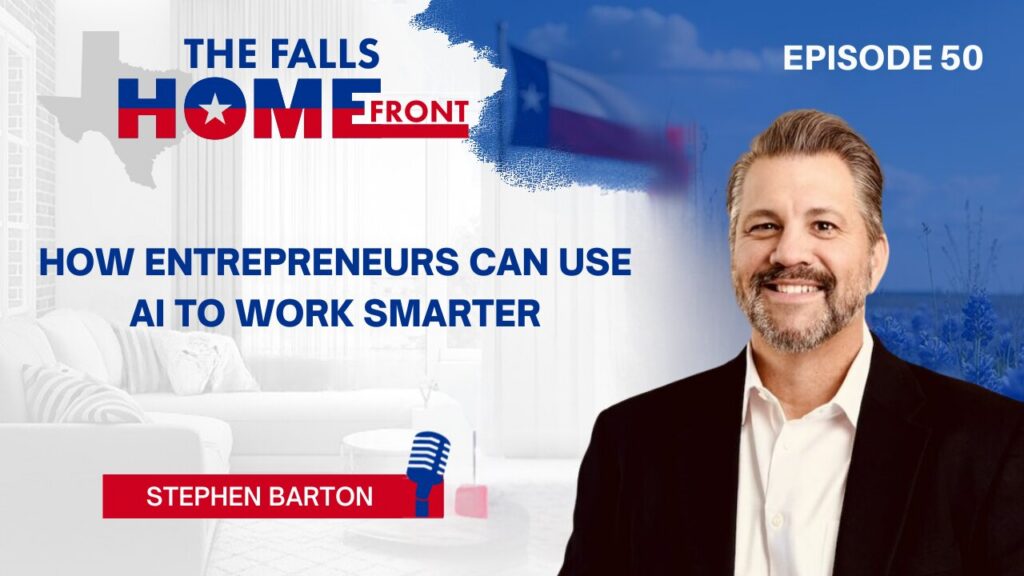
On this episode of The Falls Home Front, I sat down with Stephen Barton of Core Community Mortgage to talk about why moving fast and failing often beats sitting still.
We talk about entrepreneurship, AI, and building a business that serves people first, from mortgages to youth soccer to community giving.
Curious about this episode? Here’s a preview of our discussion:
The Entrepreneurial Roots Behind a Bias Towards Action
Stephen didn’t learn business from a textbook. He learned it from a soda shop.
Stephen’s father left a Fortune 10 corporate job to open a soda fountain in Kennedale, Texas, where Stephen began working at 12. He observed his father’s community support through car loans and home purchases, fostering employee loyalty.
In contrast, Stephen’s mother created a welcoming home for neighborhood kids, teaching him listening skills and empathy.

Those two lessons combined into one philosophy. Stephen doesn’t run Core Community Mortgage like a lending business. He runs it like a service business that happens to close loans.
Data backs up why that mindset matters. According to the Bureau of Labor Statistics, roughly one in five new business establishments fails within its first year, and the survival curve only gets steeper from there. Stephen has built five businesses. He knows the odds. He just refuses to let the odds slow him down.
Watch the full video here:
How Serving People First Built Core Community Mortgage
The first non-textbook book Stephen’s dad ever gave him was How to Win Friends and Influence People. That single idea shaped everything that came after. If you help enough people get what they need, you’ll get what you need too.
Stephen applies that rule everywhere. Mortgages. Soccer. Life. He tells people to raise their hand if they need help, and he’ll either connect them to the right person, learn how to do it himself, or find someone who can.
That approach shows up in small, deliberate moments. Stephen once couldn’t close a loan for a client. Instead of walking away, he sent the person to his own bank and let another lender close the deal. He made nothing on it. The client got a house.
“So if there’s someone, I always tell people whatever it is, I don’t care what it is, raise your hand and if I can help you, I’m either going to connect you to the person, I’m going to learn how to do it myself, or I will go figure out the right way to get it done, the person that can help. I bring that to pretty much anything I do in life; that veracity, I don’t wear out, which is pretty rare. So even at the age of 50, I probably don’t sleep enough. But I love what I do. So I don’t mind working, and especially when it comes to real estate agents, I watch people who do what I do not be available when customers are shopping for houses. A lot of times when they’re buying a house, getting the offer really hinges on about 30 minutes that you can move faster than anybody else. If you can be available, then you can help somebody get the house.”
For real estate agents, that 30-minute window is everything. Being reachable during that window can be the difference between a client winning a house or losing it to someone else.
Why Chasing Referrals Beats Chasing Transactions
I asked Stephen if business owners today spend too much time chasing transactions instead of relationships. His answer was honest, not polished.
He said it’s hard. When someone needs to pay the light bill or cover tuition, it’s tempting to prioritize the deal in front of them over the long-term relationship. That pressure pulls people away from their core values without them even noticing.
Stephen’s team has a rule for this. His business partner in the soccer facility, Wes Pingleton, put it simply: they keep their promises.
“When people are trying to pay the light bill, it forces you to look at things less relationship-based and more, I’ve got to have this thing to be able to feed my family or pay for college. And it takes you out of your core values; it takes you out of your lending principles or whatever your business is that made you want to start that business to help people to begin with. My business partner always says we keep our promises. And that’s been painful sometimes; it’s cost us money, and sometimes it’s been popular, and sometimes it hasn’t. But people know that’s our DNA, so we have to abide by that even when it means we can’t win. And that’s okay. I just talked to a person who said, ‘Hey, I can’t get this house, I don’t have enough money to close.’ And I told the team, ‘Just do a lender credit.’ And they said, ‘Well, that won’t help us, we won’t make any money.’ And I said, ‘That’s okay, that’s okay. We’re going to help them get the house.’ And you know what’s going to happen? It’s going to reciprocate to us, and they’re going to send us five referrals. I don’t know that for a fact, but it doesn’t change why we’re doing it. Our job is to help. And if it comes back to us, that’s great.”
This is the same principle behind buying that first home as a stepping stone to generational wealth. According to NAR’s Home Buyers and Sellers Generational Trends research, homeownership remains one of the most consistent paths to long-term wealth accumulation across every generation of buyers. That’s the kind of long game Stephen is talking about. Agents who build referral pipelines on trust, not transactions, are the ones still getting calls five years later. If you’re weighing whether your first purchase should double as a future rental property, our real estate investor network meets locally to talk through exactly that kind of decision.
The Soccer Spectrum Story: Turning a Bad Experience Into a Community Asset
Stephen didn’t grow up loving soccer. He grew up playing baseball, like most Texans his age. But his daughter was gifted at the sport, and the club she played for treated families poorly. No callbacks. No care for the customer.
So Stephen and his business partner, Wes, did what entrepreneurs do. They started their own club. Neither of them liked soccer much. They just didn’t like bullies more.
What began with 13 girls on one team grew into the fourth largest independent soccer club in North Texas. Over eight years, the club never took a dollar in profit. Instead, it gave back nearly $1.6 million in scholarships to families who couldn’t otherwise afford to play.
That club eventually led Stephen and Wes to take over the oldest indoor-outdoor soccer facility in Texas, now a full community hub used by every school in the area.
Preventing Burnout and Building the Big Six Foundation
Stephen was candid about a mistake he made with his own son. He let coaches influence decisions more than he should have, and his son burned out on a sport he used to love.
That experience changed how Soccer Spectrum operates. Staff has to respond to parent concerns within four hours. Kids get mandatory breaks over the holidays. Nobody is punished for missing a game to spend time with family.

Stephen wasn’t guessing about the risk here. Research from the Aspen Institute’s Project Play initiative shows that burnout and loss of interest are among the leading reasons kids quit organized sports altogether, which is exactly the pattern Stephen was trying to break.
The Big Six Foundation grew out of a similar instinct. A backyard cornhole tournament between six elementary schools has, over ten years, raised nearly a million dollars for school programs that would otherwise go without funding.
Using AI as a Bias Towards Action Tool for Real Estate Agents
Stephen’s team runs what he calls AI employees. Eleven of them, doing scheduled work every day. One scouts podcasts hosted by entrepreneurs with backgrounds similar to Stephen’s own. That’s actually how this episode came together. His AI found this show, matched our shared values, and set up the introduction.
That’s AI for real estate agents in action. Another AI employee helps agents directly.
“Like right now it’s really relevant. If you look at it for agents, the market right now is about 5.9 months of inventory, which is almost a buyer’s market. A lot of listings are sitting. So my team built an AI employee that takes a listing for our agents, runs an appraisal evaluation model for them, and then gives them a 90-day reboot of the property with social media conversations to have with the seller, confirms the pricing for them, goes through this whole 10-page deal, and gives this to them instantly to help them and help the seller. There’s another example of AI that we have that does really good stuff. And I’ll tell people this: the reason why I love AI, and I lean into it is one, I want to know how things are going to work in the future so I can teach and help protect the people around me, their businesses, and things like that. But second, it’s freeing me up to do more stuff like this. I am touching more people, I’m seeing their eyeballs more than I ever have in my business, and I’m busier than I’ve ever been with five businesses running, and I’m still getting more time to connect and be in the community and serve.”
That kind of adoption isn’t unusual anymore. A recent NAR-affiliated survey on AI use among real estate professionals found that AI has firmly moved into daily workflows for a majority of agents, even as confidence in its outputs continues to catch up.
Stephen’s advice for getting started matches that shift. Pick one paid AI tool. Load it with your own emails and background, so it learns your voice. He calls switching between tools for different tasks model hopping, and he’s strict about disclosure. His team labels every AI-generated piece of content so no client mistakes it for something else. Keeping our most recent Wichita Falls market report close at hand makes that kind of AI-assisted pricing conversation even sharper for local sellers.

What This Conversation Changed About How I Think Business Gets Built
Stephen’s bias towards action isn’t really about speed for its own sake. It’s about accepting that failure is part of the process, and that waiting to plan doesn’t reduce failure. It just delays it.
I’m walking away from this conversation more willing to treat a fast, imperfect start as real progress. Whether it’s a new listing strategy or a piece of content I’ve been putting off, I’m giving myself the same 24-hour rule Stephen described instead of letting the idea sit on a list.
Stephen runs his mortgage business through Core Community Mortgage’s home loan programs, and you can find more about his background on his loan officer profile. He’s also active on Facebook, Instagram, and LinkedIn, where he shares more on mortgages, entrepreneurship, and community work.
Want to hear my entire conversation with Stephen Barton about building a bias towards action and using AI to grow your real estate business? Listen to our podcast episode!
Listen Here


FAQ
What is Core Community Mortgage known for?
Core Community Mortgage, founded by Stephen Barton, operates on a service-first philosophy that prioritizes client outcomes and availability over transaction volume.
How did Soccer Spectrum start?
Soccer Spectrum began after Stephen Barton and a business partner, unhappy with how their daughters’ youth soccer club treated families, decided to build their own club instead.
How does Stephen Barton use AI in his business?
Stephen Barton runs several AI tools he calls AI employees, handling tasks like sourcing podcast guest opportunities, running listing appraisal evaluations for agents, and drafting blog content he personally edits before publishing.
If a remodel is part of your plan before listing, this recent breakdown of smart remodeling decisions before a Wichita Falls listing pairs well with the pricing strategy Stephen described above. You can also catch more conversations like this one in our archive of past episodes of The Falls Home Front.
Who is Tim Lockhart, and what makes him qualified to help?
Tim Lockhart is a retired U.S. Air Force Major and Certified Military Relocation Professional (MRP) who spent his final assignment as Director of Operations at the 366th Training Squadron at Sheppard AFB. Since 2012 he’s helped 300+ families buy and sell around Wichita Falls — many PCSing in or out of Sheppard AFB — using VA loans, BAH-aware budgeting, and remote-friendly tools for tight PCS timelines. See how Tim helps military families relocate to Wichita Falls →
Apply As A Guest On The Falls Home Front Podcast
Stephen Barton didn’t set out to run a mortgage company, a soccer facility, and a charitable foundation at the same time. He built each one by acting on an idea instead of waiting for a perfect plan, and that same willingness to show up is what makes a guest worth featuring here.
If you’re actively working in real estate, mortgage, or a related field in North Texas and solving real problems for real people, apply to be a podcast guest today.
This podcast is produced by the Icons of Real Estate, #1 Real Estate Podcast Network. If you are a real estate professional, apply to be a guest speaker across the network.
You can also follow this show and stay in touch through Facebook, Instagram, LinkedIn, or YouTube.
Disclaimer
This episode of The Falls Home Front is for informational and entertainment purposes only. Host Tim Lockhart is a licensed REALTOR® in Texas. The entrepreneurship, mortgage, and AI strategies discussed do not constitute financial, legal, or lending advice. Consult appropriate licensed professionals regarding your specific situation.
About Tim Lockhart
Tim Lockhart is a Wichita Falls Sheppard AFB PCS Home Selling & Exit Strategy Specialist for military homeowners. He works with active duty personnel preparing for PCS moves to help them determine the right strategy for their home—whether to sell, hold, or adjust timing—before executing the plan. Tim is a REALTOR® with Keller Williams Wichita Falls and a RamseyTrusted real estate agent. He is a retired U.S. Air Force officer with over a decade of experience helping clients navigate complex, time-sensitive real estate decisions in Wichita Falls, Burkburnett, and Iowa Park. If you have PCS orders and need a clear plan for your home, schedule a consultation to map out your next step.- How a Pink-Stained Rental Disaster Led David Edwards of CoLiving Operations to a $2,000-a-Month Housing Model - October 20, 2026
- Why JC San Pedro of Amplify Credit Union Warns Buyers Not to Spend Their Full Pre-Approval - October 5, 2026
- What Is Really Happening in the Wichita Falls Housing Market This Fall? - October 2, 2026
- Why Smokey Garrett of The GO Network Believes AI Will Make Great Agents Impossible to Replace - September 28, 2026
- Why Did a Wichita Falls REALTOR® Step Up as a Founding KW Military Ambassador in Texas? - September 24, 2026
- Kelly Thompson of Shearman Roofing and Construction Explains Why the Best Roofers Slow Down First - September 22, 2026
- Lawrence Courtien of Buffalo Property Inspections on the Inspection Mistake That Costs Buyers Thousands - September 14, 2026
- Will Clark of Clark Design Studio Reveals the One Design Choice That Saves Wichita Falls Homeowners Thousands - September 8, 2026
- How Gaby Lockhart of Barrett Financial Group Turns a Lender’s No Into a Yes for Wichita Falls Buyers - September 3, 2026
- Should Military Families Hold Real Estate as an Investment Instead of Selling It? - August 27, 2026