
A high-performance home is planned well before choosing finishes. Building a custom home is a major financial decision, with crucial choices involving insulation, HVAC sizing, wall and roof systems, and the home’s placement. These factors affect comfort and affordability for years.
That is exactly what we dug into on this episode of The Falls Home Front. I sat down with master builder Matt Mitchell of James Andrews Custom Homes to show you where most homeowners go wrong, and how to get it right.
Curious about this episode? Here is a quick preview of our conversation on building a smarter custom home:
Why I Wanted a Master Builder to Rethink How We Build Homes
As a Wichita Falls REALTOR, I watch buyers fall in love with countertops and forget the parts of a home they actually live inside. That is why I brought in someone who thinks the opposite way. James Andrews Custom Homes builder Matt Mitchell is the founder of the company, a Graduate Master Builder, a Master SIP Builder, and a Past President of the Dallas Builders Association. He has built super high-performance homes since 2002.
What pulled me in is something every homeowner here is starting to feel. Matt pointed to new data centers coming onto the Texas grid and driving energy prices up, which is exactly the story behind what the Skybox data center could mean for local home prices and rent. When bills climb, how a home performs stops being a luxury question.
New construction is reshaping our market at the same time. I have seen how disciplined new development protects long-term home values across our fastest-growing neighborhoods. Matt does not think in decades. He told me he thinks in centuries, and after this conversation I understand why.
Watch the full conversation here:
The Performance Choices Most Dream-Home Plans Ignore
Most dream-home planning fixates on cabinets, counters, and flooring. Matt’s point is simple. The decisions that pay you back every month are the ones people skip. Good insulation quietly puts money back in your pocket for as long as you own the house.
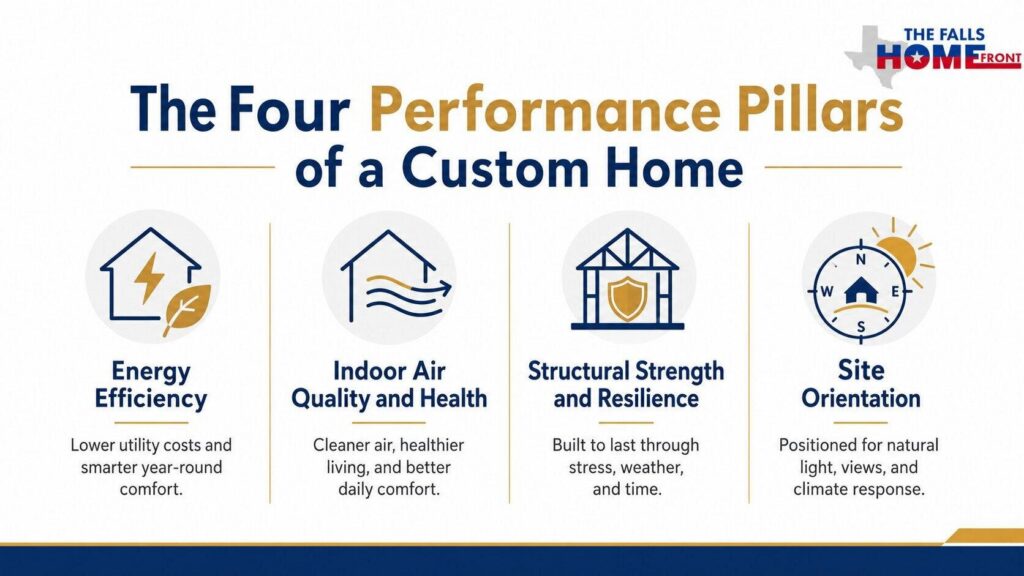
He weighs three things on every build. As a custom home builder in North Texas, energy efficiency comes first because a tighter home needs a smaller mechanical system. Then comes health, since a poorly built new home can trap moisture and turn toxic. Last comes strength, which matters a great deal near the Red River where storms hit harder than they do down in Dallas.
Orientation surprised me most. Matt explained that twisting a house ten to twenty percent on its lot, or cutting back on south and west-facing glass, can save real money at almost no added cost. He walks through the bigger structural version of this in his own foundation, frame, and roof choices that protect resale value. National guidance agrees on the payoff, and the EPA lays out why tight, energy-efficient homes stay healthier to live in.
Here is the part homeowners miss. Performance is decided on paper, long before the drywall goes up. Use the building science at the design stage, and most of these wins cost little or nothing.
Why an Oversized AC Unit Quietly Ruins a New Home
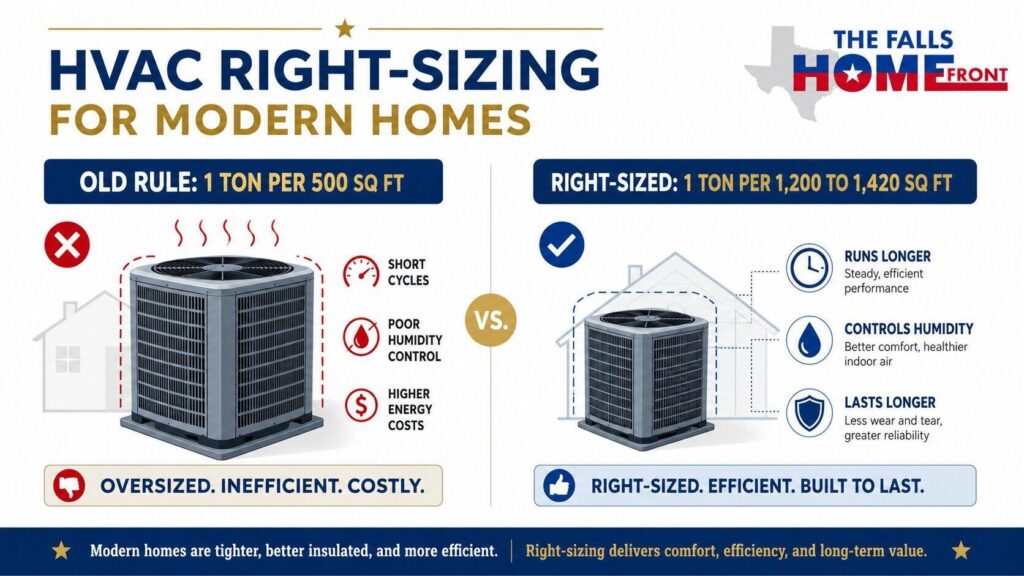
Tight modern homes changed the HVAC math completely. The old rule of one ton of cooling for every 500 square feet is gone. Matt Mitchell and his team at James Andrews Custom Homes size closer to 1 ton per 1,200 to 1,420 square feet, so the system runs longer and works less violently.
Here is why bigger is not better, in his own words.
“If you put a system that’s too big into a new house, people think, ‘Oh, that’s so great, because it’s going to turn on and cool my house down really quickly.’ And it will. But that creates a problem. The system will turn on and run for a short period of time and then shut back off, and that’s called short cycling. Any piece of appliance or equipment that you’re constantly turning on and off, it shortens its lifespan. It’s like sitting in a car at a red light, and when the light turns green, you smash the accelerator as hard as you possibly can, and then when you get to another red light, you smash on the brakes as hard as you can. You can do that, and it’ll work, but your car won’t last as long. It’s just really hard on the equipment.”
Variable-speed units fix this by ramping up slowly instead of slamming on. That saves energy and equipment life together. Because the system runs longer, it also pulls more moisture out of the air, and controlling humidity is what stops mold in an airtight house. Tight homes do need deliberate fresh-air planning, and the EPA explains how much fresh air a tightly sealed home actually needs using national ventilation standards.
A bigger unit feels like a luxury on move-in day. It behaves like a liability every year after that.
The Panel System That Makes a Home Stronger and Cheaper to Run
A super high-performance home adds something beyond efficiency, and that is raw strength. For exterior walls and roofs, custom home builder Matt Mitchell of James Andrews Custom Homes uses structural insulated panels (SIPs). He described them to me as two to five times stronger than stick framing and roughly 65 to 70 percent more energy efficient.
The history surprised me. SIPs are not new at all. Frank Lloyd Wright used stressed-skin panels in his Usonian homes, and Alden B. Dow, a student of Wright’s and son of the Dow Chemical founder, built the first foam-core panel in 1952. On the jobsite, they go up almost like Legos, with windows, doors, and roof pitches precut in a factory and tilted into place. The interior walls are still framed the traditional way.
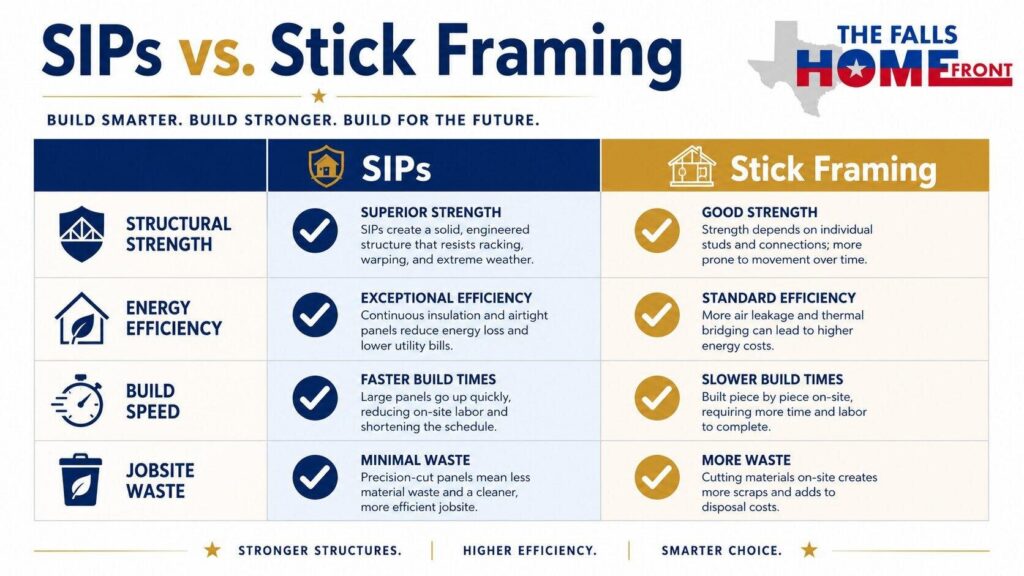
The practical case is what won me over. A SIP build runs about the same price as a properly built stick home, frames a little faster, and wastes far less material. Matt also sees fewer callbacks, because the hardest cuts happen in a controlled factory instead of the field. The Department of Energy backs the approach and explains why building energy efficiency in from the start beats retrofitting later, and it names SIPs directly.
Stronger, tighter, and about the same money. That combination is hard to argue with.
Remodel or Build New, and Why Inspections Are Never Optional
When a client cannot decide between remodeling and building new, Matt starts with two questions. What are your end goals, and how long do you plan to stay? The answers usually point the way faster than any spreadsheet.
His warning on remodels stuck with me.
“I start with what their end goals are. How long do they plan on being in the house? Typically, if you’re remodeling the entire house, the cost to remodel is about twice as expensive as new construction. One of the main drivers of that is that when you’re doing demolition, you have to be careful. You can’t just go in and tear down the walls, because you have to take into account where the load-bearing walls are. And in a remodel, you have no idea what you’re dealing with until you crack that house open. You don’t know what mistakes were made. I’ve remodeled houses that had been added onto three or four times, and the stuff you find that someone may have done 40 years ago can be crazy. You’ve got to fix all that, but you don’t know that you have to fix it until you get into it.”
New construction is not surprise-free, but the surprises are smaller and easier to iron out. That predictability shows in the finished product, which you can see in high-performance custom homes he has built across North Texas. A remodel hides its worst problems until the walls are open, and by then they are expensive.
That is also why Matt never lets a client skip inspections to save a little money. A third party with no stake in the job catches the honest mistakes any electrician or framer can make on a bad day. Even out in the county with no city jurisdiction, he still hires a private inspector and has the engineer verify the foundation before any concrete gets poured. Demand for this kind of quality is only rising, which I unpacked in the housing demand driving new construction across Wichita Falls.
Fixing a mistake before drywall is cheap. Fixing it after your family moves in is not.
What This Conversation Changed About How I Vet a Builder
“Nobody knows it all. Everybody has to be in a constant state of learning. I teach classes, but I also take classes. If you ever run across a builder or an architect who thinks they know it all, run from them. They don’t. Nobody does. If I were to stack all the code books- the International Building Code, the Residential Code, the Energy Conservation Code, the mechanical code, the plumbing code- it’s a giant stack, dense with information and things that have to be done properly. So you need to find a builder that’s constantly trying to learn. Are they taking classes? Are they learning things? What’s their background?”
That reframed how I judge a builder. I used to look hardest at the portfolio. Now I look at whether they keep learning, because the codes change every three years and the science moves right along with them.
It also changed the order I recommend. I tell clients to bring a builder in early, even alongside the architect, because a builder tracks budget and material swings that an architect rarely follows day to day. Matt and I agreed that a good local REALTOR belongs in that early conversation too, to flag floodplains, soil, and neighborhood foundation history before anyone falls in love with a lot. If you want to follow his ongoing high-performance home projects, that is the easiest place to see this thinking in action.
Custom Home Building Questions I Hear Most Often
Does a high-performance home cost more to build?
Compared to a properly built stick home, a SIP-built high-performance home runs about the same price. The difference shows up in the monthly energy bill, not the construction budget.
What size air conditioner does a new, tight home need?
Far smaller than the old one-ton-per-500-square-feet rule. Matt sizes closer to one ton for every 1,200 to 1,420 square feet, so the system runs longer, controls humidity better, and lasts longer.
Should I remodel or build new?
Start with your end goals and how long you plan to stay. A full remodel often costs about twice as much as new construction because of hidden problems you cannot see until the walls are open.
Want to hear my entire conversation with Matt Mitchell on building science, SIPs, and HVAC sizing for new homes? Listen to the full podcast episode!
Listen Here


Who is Tim Lockhart, and what makes him qualified to help?
Tim Lockhart is a retired U.S. Air Force Major and Certified Military Relocation Professional (MRP) who spent his final assignment as Director of Operations at the 366th Training Squadron at Sheppard AFB. Since 2012 he’s helped 300+ families buy and sell around Wichita Falls — many PCSing in or out of Sheppard AFB — using VA loans, BAH-aware budgeting, and remote-friendly tools for tight PCS timelines. See how Tim helps military families relocate to Wichita Falls →
Apply to Be a Guest on The Falls Home Front Podcast
North Texas is growing fast, energy costs are climbing, and the way we build homes is changing every few years. If you are solving real problems in this market, whether in building, finance, brokerage, or development, I would love to have you on the show. You can also keep up with everyday life and homes around Wichita Falls and my ongoing North Texas real estate insight between episodes.
DISCLAIMER: This podcast is for informational and entertainment purposes only. Host Tim Lockhart is a licensed REALTOR® in Texas, but the building insights shared here do not constitute professional engineering or contracting advice. Consult licensed professionals for your specific project needs.
About Tim Lockhart
Tim Lockhart is a Wichita Falls Sheppard AFB PCS Home Selling & Exit Strategy Specialist for military homeowners. He works with active duty personnel preparing for PCS moves to help them determine the right strategy for their home—whether to sell, hold, or adjust timing—before executing the plan. Tim is a REALTOR® with Keller Williams Wichita Falls and a RamseyTrusted real estate agent. He is a retired U.S. Air Force officer with over a decade of experience helping clients navigate complex, time-sensitive real estate decisions in Wichita Falls, Burkburnett, and Iowa Park. If you have PCS orders and need a clear plan for your home, schedule a consultation to map out your next step.- How a Pink-Stained Rental Disaster Led David Edwards of CoLiving Operations to a $2,000-a-Month Housing Model - October 20, 2026
- Why JC San Pedro of Amplify Credit Union Warns Buyers Not to Spend Their Full Pre-Approval - October 5, 2026
- What Is Really Happening in the Wichita Falls Housing Market This Fall? - October 2, 2026
- Why Smokey Garrett of The GO Network Believes AI Will Make Great Agents Impossible to Replace - September 28, 2026
- Why Did a Wichita Falls REALTOR® Step Up as a Founding KW Military Ambassador in Texas? - September 24, 2026
- Kelly Thompson of Shearman Roofing and Construction Explains Why the Best Roofers Slow Down First - September 22, 2026
- Lawrence Courtien of Buffalo Property Inspections on the Inspection Mistake That Costs Buyers Thousands - September 14, 2026
- Will Clark of Clark Design Studio Reveals the One Design Choice That Saves Wichita Falls Homeowners Thousands - September 8, 2026
- How Gaby Lockhart of Barrett Financial Group Turns a Lender’s No Into a Yes for Wichita Falls Buyers - September 3, 2026
- Should Military Families Hold Real Estate as an Investment Instead of Selling It? - August 27, 2026