
Can a regular home inspection tell you if your kitchen could flood during a heavy rainstorm?
What if your dream home has risks the inspection missed? What if those risks could affect your insurance costs, safety, or resale value?
A standard home inspection cannot tell a buyer whether their future kitchen will flood during a heavy rainstorm. That is the gap I dig into on this episode of The Falls Home Front with Albert Slap, President and Co-Founder of Risk Footprint.
Albert has spent the last decade building Risk Footprint property risk assessments, natural hazard data that helps homeowners, agents, and lenders spot the flood, hail, wind, and wildfire risks that hide in plain sight long after the inspector leaves.
Curious about this episode? Check out the snippet of this conversation below for a quick preview of what Albert and I dug into.
The Property Risks Buyers Need to Investigate Before Closing
A home purchase pulls in a small army of professionals. There is an agent, a lender, an appraiser, a title company, an insurance agent, and a home inspector. My conversation with Albert reinforced a concern I see often. Even with that much expertise in the room, buyers can still miss the full picture of a property’s natural-hazard exposure.
None of those professionals evaluate every flood, hail, wind, wildfire, or tornado scenario a property might face. Albert’s background explains why he built something that does. Before co-founding Risk Footprint, he practiced and taught environmental law. He later partnered with scientists from the University of Miami and Florida Atlantic University to turn commercial-grade geospatial data into a report an everyday buyer could actually use.
Watch the full conversation here:
Albert put it simply on the show. “We’ve been automated and available online for a decade. It’s environmental. It’s not pollution-related or underground tanks. It’s what I tongue-in-cheek call Mother Nature butt kicking.”
That distinction matters. This is not about radon or old fuel tanks. It is about wind, water, and fire, the forces most likely to hit a home’s value and safety over time.
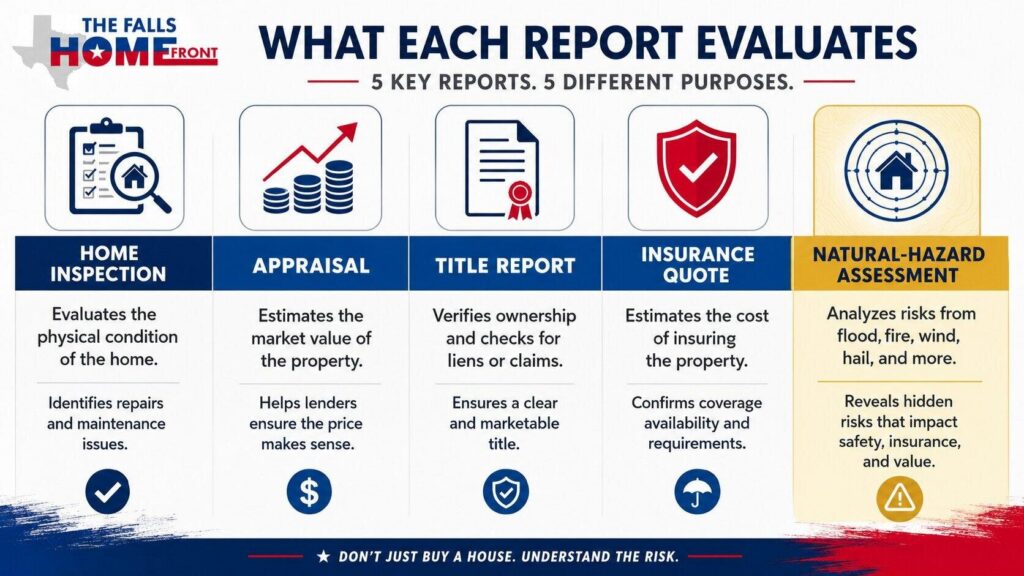
Due Diligence Comparison Table
Why Property Risk Research Should Happen Before an Offer
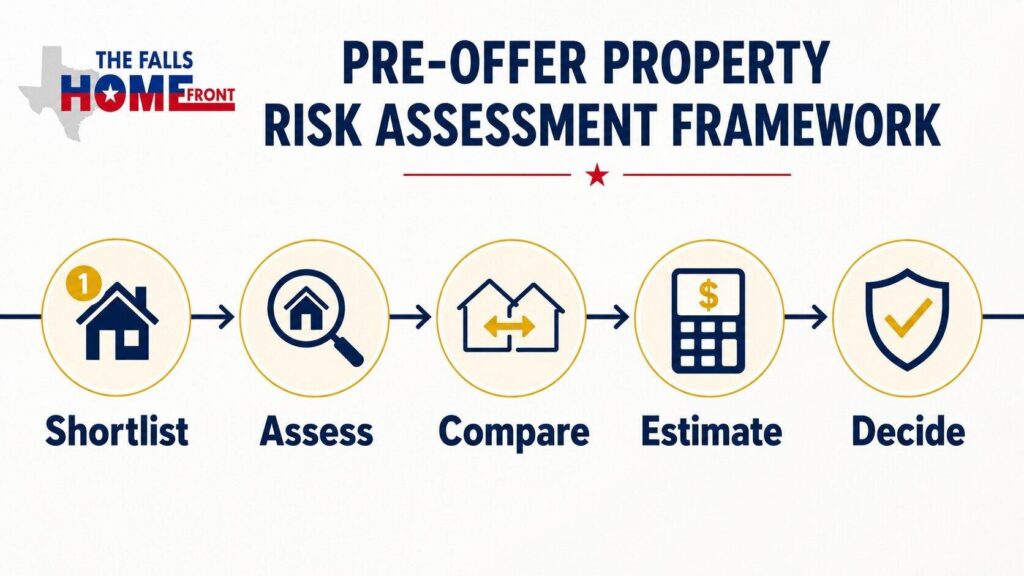
Once a buyer signs a purchase agreement, the due diligence clock starts ticking. Albert’s approach is to do the hazard homework earlier, while a buyer still has two or three homes on a shortlist and no contract tying them to any single address.
“Natural-hazard due diligence should happen before a buyer signs the agreement of sale, not after the inspection period has already started. Once buyers narrow their options to two or three homes in the right neighborhood, agents can help them compare elevation, drainage, flood exposure, and insurance considerations. That information doesn’t necessarily eliminate a home from consideration, but it gives the buyer time to understand the potential costs and decide which property best matches their financial capacity and tolerance for risk.”
That single shift changes the question a buyer asks. Instead of “is this a good house,” they can ask which finalist offers the strongest mix of lifestyle, affordability, and long-term resilience. A flood and climate risk assessment run early in the search puts real numbers behind that comparison instead of a gut feeling.
Pre-Offer Property Risk Framework
What Hurricane Harvey Revealed About FEMA Flood Zones
Albert brought up Hurricane Harvey almost immediately, and the number stopped me. Roughly 120,000 homes flooded in the Houston area in 2017 outside FEMA’s mapped 100-year floodplain. Because those homes sat outside the high-risk zone, federal law never required their owners to carry flood insurance. Most did not have it, and most rebuilt out of pocket.
FEMA maps remain useful, but they were built for floodplain management and insurance requirements, not as a guarantee that a specific address stays dry. Localized rainfall, drainage failures, and small elevation differences between nearby properties can all push water somewhere a map never anticipated. That gap is well documented. Federal watchdog reviews of the flood insurance program have flagged that FEMA’s maps often lag behind actual flood risk as rainfall patterns and development shift. FloodSmart, the National Flood Insurance Program’s own consumer site, confirms the same pattern, noting that a large share of flood claims come from outside officially designated high-risk zones.
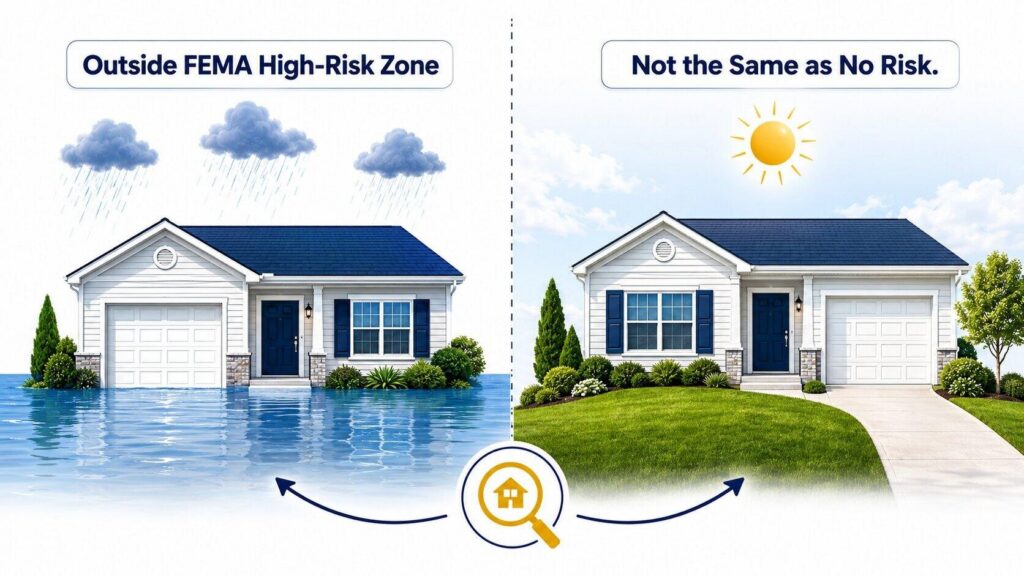
Albert lives that reality himself. His Florida townhouse sits in a FEMA X Zone, the map’s lowest-risk designation. But his own property-level review—an Environmental risk assessment for real estate—showed that runoff from a neighboring golf course could still reach his kitchen during a severe rainstorm. He carries flood insurance anyway, at about $700 a year, because the data revealed what the zone label did not. “Not required” and “not at risk,” he told me, are not the same conclusion.
FEMA Zone vs. Actual Flood Risk
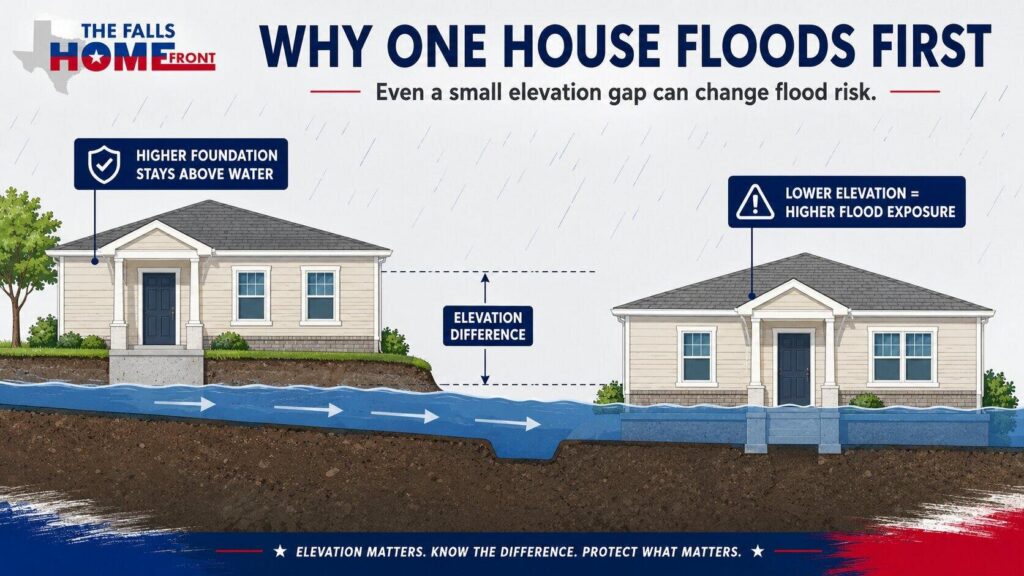
Why Elevation Can Change a Home’s Flood Exposure
Real estate professionals love to say location, location, location. Albert added a layer to that: elevation, elevation, elevation. A street can look level while hiding enough grade variation to send water toward one house and away from the one next door.
“Real estate professionals often emphasize location, but when we evaluate flooding, elevation can be just as important. Two homes on the same street may look almost identical while having very different exposure because one finished floor sits higher than the other or because the surrounding land directs water toward one property. Agents should avoid assuming that every home in a neighborhood carries the same flood risk and instead help buyers investigate the grading, drainage, entry points, and elevation of the specific property they are considering.”
I have changed how I talk about this with clients. Instead of saying a neighborhood does not flood, I now say let’s look at how this specific property sits within it and what the data shows. A closer look at why property inspections are crucial for real estate decisions makes the same point: the individual property, not the neighborhood average, is what actually matters.
Neighboring Homes During a Heavy-Rain Event
How Buyers Can Separate Property Risk From a Bad Purchase
A property with known risk is not automatically a bad purchase. Every property carries some exposure. The real question is whether the buyer understands it, can afford to manage it, and still believes the home fits their goals.
Albert illustrated risk appetite with an extreme example. Indian Creek Island near Miami holds 41 billionaire-owned homes sitting barely a few feet above sea level, including neighbors Jeff Bezos and Mark Zuckerberg. Neither would build a corporate data center at that elevation, yet a $150 million residence carries a completely different risk calculus than a typical family’s largest financial asset.
For most families, a home is the largest investment they will ever make. A major uninsured loss could erase savings or delay retirement for years. The right decision might be to buy and add coverage. It might be to negotiate repairs first. It might be to walk toward a different property with a better risk profile. What matters is making that call on purpose, not discovering the consequences after a disaster.
The Smartest Home Improvements Aren’t Always the Most Visible
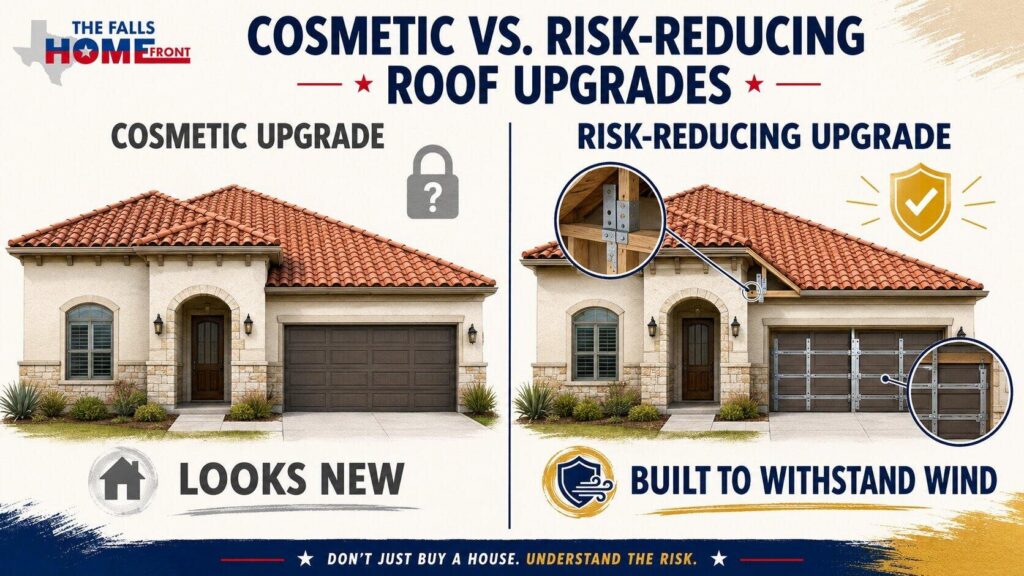
Albert’s own townhouse became the clearest example in our conversation. Hurricane wind drives most of his insurance premium, not the risk of a small roof leak. The real threat is wind separating the roof structure from the walls.
Instead of spending $40,000 to $50,000 replacing decorative roof tiles, Albert spent about $5,000 having a team strengthen his roof-to-wall connections and reinforce his garage door.
“Homeowners are often told to replace a roof because it’s visible, familiar, and easy to explain, but a new roof covering may not address the structural failure that creates the greatest risk. In a severe hurricane, the bigger concern may be whether the roof is properly connected to the walls and whether the garage door can withstand wind pressure. By identifying the actual point of failure first, homeowners can direct their money toward improvements that make the property safer, potentially reduce insurance exposure, and provide more meaningful protection than a cosmetic upgrade alone.”
That lesson traces back to 1992, when Hurricane Andrew blew tens of thousands of roofs off South Florida homes and forced a rewrite of the state and county building codes to require stronger straps, clips, and nailing patterns. Homes built before that update, like Albert’s 1989 townhouse, often need retrofitting to meet the newer standard. The FORTIFIED home resilience program, built by wind-safety researchers, documents exactly which connection points matter most, and a licensed roofing and storm-damage specialist can tell you whether a home already meets them. Other low-cost improvements Albert mentioned include doorway flood barriers, regrading landscaping away from the foundation, elevating HVAC equipment, and clearing defensible space for wildfire protection.
Cosmetic Upgrade vs. Risk-Reducing Upgrade
Why Insurance Is Only One Layer of Protection
Even with a policy in place, an owner can still face high deductibles, exclusions, coverage limits, depreciation calculations, and delayed claim payments. Albert was direct about this. Insurance is not a get-out-of-jail-free card.
“I would say that’s a little bit of wisdom, which is pick of the three top of your list, the one that is safest. And if you don’t do that, if you really wanna fall in love with the house, just make sure that you have enough money in the bank because the insurance is not gonna cover everything. So you’re going to have risks that will need to be self-insured, paid for from your own pocketbook.”
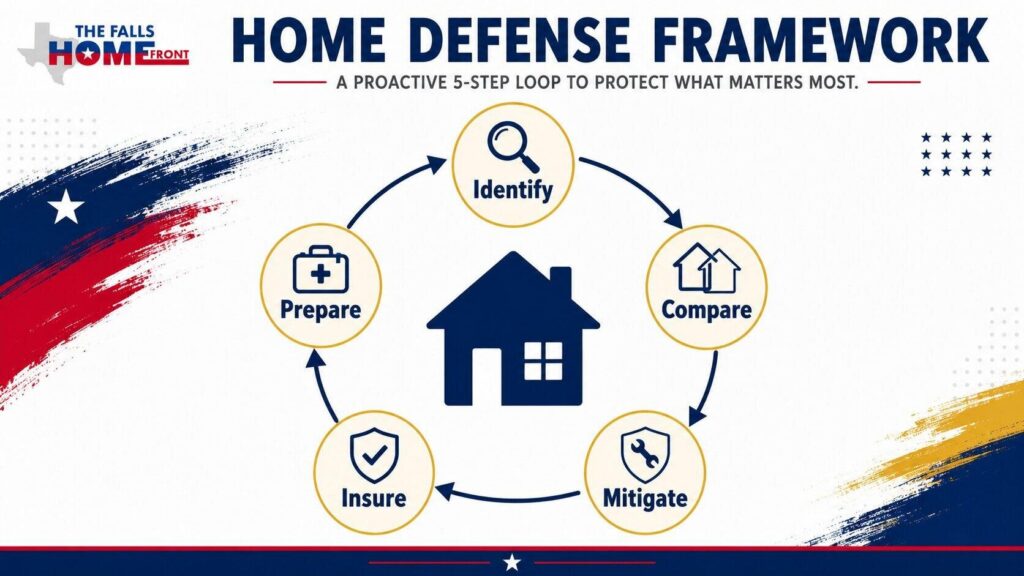
A stronger approach layers hazard identification, preventive improvements, an emergency plan, appropriate insurance, and cash reserves for whatever falls outside the policy. A recent look at property resilience assessments walks through exactly how those layers fit together for a single address.
What Changed for Me After This Conversation
I asked Albert what he would insist his own daughter answer before signing closing papers on her first home. His response was not about ordering a report. It was about not falling in love with a structure before comparing it honestly against the alternatives.
“Don’t fall in love with a house. A house is a house, and we make it; my wife and I make it a home. It’s not that the physical structure is nice, but it’s that you want a safe and secure place to build a home, which does not happen outside of the people, the humans that are living in it. A house can have the finishes, the yard, and the layout a buyer wants. A home is still built by the people living in it, and the property needs to be a safe, financially sustainable place for that life to happen.”
My biggest takeaway is that good decisions depend on questions a buyer may not know to ask. Someone who has never flooded may assume a low-risk FEMA label settles the matter. Someone who sees a newer roof may assume the home is protected from wind. Those assumptions feel reasonable until the underlying risk actually gets checked.
I now think about property resilience as a form of defense, since a home does not exist apart from the weather, drainage, and development around it. Do not rely on a single score. Do not confuse compliance with safety. Do not assume a neighboring property carries the same exposure. Do not wait until after signing to look closer.
This matters here in North Texas, where homeowners already deal with hail, tornadoes, drought, extreme heat, and flooding in the same calendar year. None of that should scare a buyer away. It should make them a little more prepared. Reviewing tornado safety guidelines alongside a property’s hazard report is a simple way to close that gap, and keeping up with routine property upkeep keeps small maintenance issues from becoming the kind of structural failure point Albert described in his own attic.
Home-Defense Framework
Want to hear my entire conversation with Albert Slap of Risk Footprint Property Risk Assessments about the hidden natural hazard risks that could be lurking beneath the surface of your dream home? Listen to our podcast episode!
Listen Here


Frequently Asked Questions About Property Risk Assessments
What does a natural-hazard property assessment evaluate?
It uses location-specific data and modeling to evaluate how hazards like flooding, hail, wildfire, wind, tornadoes, and landslides may affect an individual property.
Is a property-risk assessment the same as a home inspection?
No. A home inspection evaluates the visible condition of the structure. A natural hazard property assessment considers how external environmental hazards may affect the property in the future.
Can a house flood outside a FEMA flood zone?
Yes. A property can be outside a FEMA high-risk zone and still experience flooding from extreme rainfall, inadequate drainage, or local elevation conditions. This is one of the clearest FEMA flood zone limitations buyers run into.
When should a buyer order a property-risk report?
Before signing a purchase agreement, buyers can use the information to compare shortlisted properties and estimate insurance and mitigation costs while they still have options, which is the core of solid homebuyer due diligence.
Does a high-risk result mean the buyer should reject the property?
Not necessarily. The result should lead to a deeper look at probability, severity, insurance options, mitigation costs, and financial capacity, along with realistic property resilience improvements the buyer can make after closing.
Where can buyers learn more about Albert Slap and Risk Footprint?
You can review Risk Footprint’s ASTM property resilience assessment standard or download their sample scope-of-work template for a look at what a full report includes. Albert and his team are also active on Facebook and LinkedIn. You can find more of my own conversations on real estate strategy through my website, Instagram, and LinkedIn.
Who is Tim Lockhart, and what makes him qualified to help?
Tim Lockhart is a retired U.S. Air Force Major and Certified Military Relocation Professional (MRP) who spent his final assignment as Director of Operations at the 366th Training Squadron at Sheppard AFB. Since 2012 he’s helped 300+ families buy and sell around Wichita Falls — many PCSing in or out of Sheppard AFB — using VA loans, BAH-aware budgeting, and remote-friendly tools for tight PCS timelines. See how Tim helps military families relocate to Wichita Falls →
Apply to Be a Podcast Guest
Real estate decisions keep getting more complex as owners navigate shifting insurance markets, extreme weather, and new technology. If you work in real estate, construction, finance, insurance, or community resilience, and you have a perspective that could help North Texans make smarter decisions, I would like to hear it.
About Tim Lockhart
Tim Lockhart is a Wichita Falls Sheppard AFB PCS Home Selling & Exit Strategy Specialist for military homeowners. He works with active duty personnel preparing for PCS moves to help them determine the right strategy for their home—whether to sell, hold, or adjust timing—before executing the plan. Tim is a REALTOR® with Keller Williams Wichita Falls and a RamseyTrusted real estate agent. He is a retired U.S. Air Force officer with over a decade of experience helping clients navigate complex, time-sensitive real estate decisions in Wichita Falls, Burkburnett, and Iowa Park. If you have PCS orders and need a clear plan for your home, schedule a consultation to map out your next step.- What Is Really Happening in the Wichita Falls Housing Market This Fall? - October 2, 2026
- Why Smokey Garrett of The GO Network Believes AI Will Make Great Agents Impossible to Replace - September 28, 2026
- Why Did a Wichita Falls REALTOR® Step Up as a Founding KW Military Ambassador in Texas? - September 24, 2026
- Kelly Thompson of Shearman Roofing and Construction Explains Why the Best Roofers Slow Down First - September 22, 2026
- Lawrence Courtien of Buffalo Property Inspections on the Inspection Mistake That Costs Buyers Thousands - September 14, 2026
- Will Clark of Clark Design Studio Reveals the One Design Choice That Saves Wichita Falls Homeowners Thousands - September 8, 2026
- How Gaby Lockhart of Barrett Financial Group Turns a Lender’s No Into a Yes for Wichita Falls Buyers - September 3, 2026
- Should Military Families Hold Real Estate as an Investment Instead of Selling It? - August 27, 2026
- What Ian McMurtrie and Rita Beemen of Raconteur Press Taught Me About Owning Your Own Story - August 26, 2026
- Is a VA Loan Really Weaker Than a Conventional Offer for Wichita Falls Sellers? - August 24, 2026