

Can one house earn twenty times more while housing people who are priced out of their own city? Co-living says yes. You rent a well-designed home by the room to working adults who can’t afford to live near their jobs.
On this episode of The Falls Home Front, I talked with David Edwards of CoLiving Operations, a Houston operator who manages more than 400 rooms. He turned a $100-a-month rental into a $2,000-a-month property. Then he built the systems to help other investors do it right.
Curious how the numbers actually work? Here’s a quick preview of our conversation:
How One Tenant Disaster Made Co-Living the Smarter Rental Strategy
David’s co-living story starts with a house that turned pink.
He moved from New York to Houston after a popular real estate investing community pointed to it as a strong market for new investors. He and his wife flipped properties and purchased a long-term rental, adhering to standard investment practices such as hiring a property manager and investing in C+ neighborhoods for cash flow.
Then COVID hit, and the property manager couldn’t get inside.
A single mom tenant initially seemed ideal but lost her job and turned David’s house into a strip club, pit bull breeding business, and meth dispensary. After 11 months, she vanished, leaving behind bolted couches, a stripper pole, and a pink-tinted home, with paint spread throughout the house due to the running AC.
The damage came to about $40,000. The turn took him two and a half months.
So David asked himself a simple question. What went wrong? The answer was access. A single tenant controlled his asset, and he couldn’t see inside it.
Then he heard the founder of a national rent-by-the-room platform on a podcast, and co-living clicked. The common areas stay common, so he can walk in any time. A room turn takes about two hours. A hole in the drywall costs $150 to $200 and gets fixed in a day. Add the fact that a house earning about $100 a month as a single-family rental could earn around $2,000 as co-living, and he called converting a single-family home to co-living a no-brainer.
Five years later, he runs co-living property management and setup services for investors across multiple markets.
Watch the full episode here:
What Makes a House Work for Co-Living: Parking, Transit, and Floor Plan
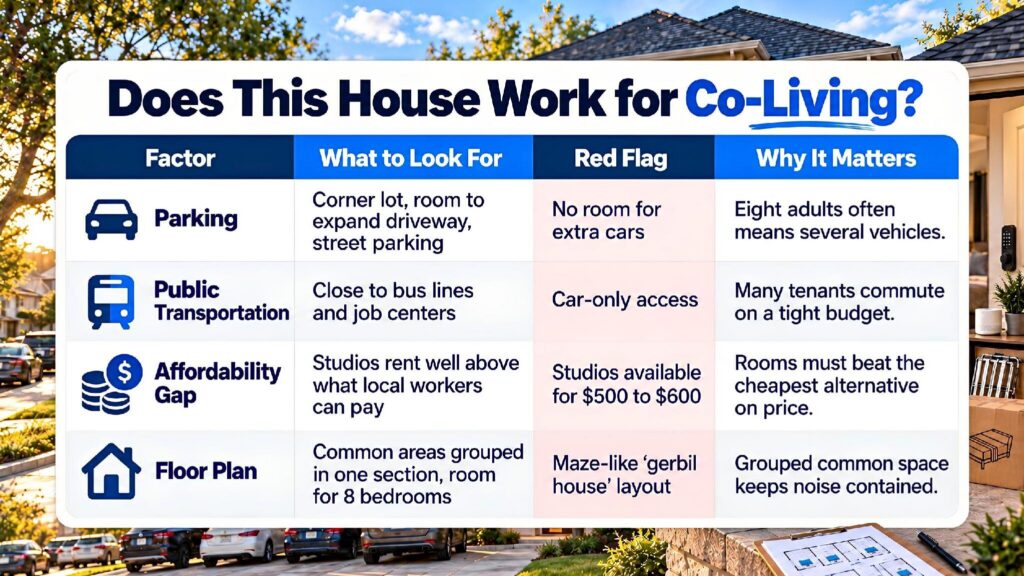
David prioritizes parking over price or bedroom count. Key factors include corner lot status, backyard parking potential, driveway expansion, and curb space. With eight adults, ample parking is essential.
He checks public transportation distance and affordability, as co-living is viable where there’s a housing gap. It suits areas where individuals with $30,000-a-year jobs, like fast-food workers or rideshare drivers, struggle to afford nearby living.
That gap is real. The latest national research on renter cost burdens from Harvard’s Joint Center for Housing Studies found a record 22.7 million renter households paying 30% or more of their income for housing in 2024. Among renters earning under $30,000, the share is far worse. That is exactly the workforce David serves, and why he sees co-living as affordable workforce housing first.
The floor plan is the last filter. David calls his approach “the machine.” He standardizes everything from layouts to furnishings to paint colors. Ideally, the kitchen, laundry, and gathering areas sit in one section of the house. That keeps the noise in one place, where insulated walls and solid-core doors can contain it.
For local investors, this lens changes how you read a listing. Before you run numbers on any property, it helps to understand what’s happening in the Wichita Falls housing market this fall and where workforce rents actually sit.
The Eight-Bedroom Math Behind $2,000 a Month in Cash Flow
This is the part I’d rewatch if I were running numbers on a deal. David’s minimum target today is eight bedrooms, and he explained exactly what each room pays for.
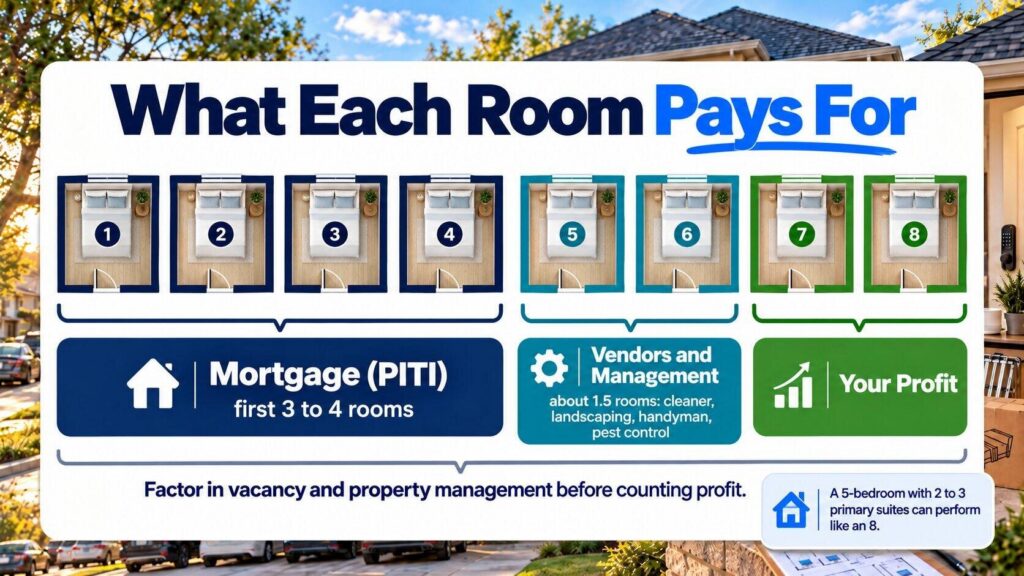
“Minimum eight today. Your first three or four bedrooms, that’s gonna make your PITI payment, right? And then you’ve got your next one and a half bedrooms is gonna be taking care of your vendors, your cleaner, your landscape, your handyman, your pest control. Some property management will be involved there as well. It’s your last two rooms, your rooms seven and eight, that tend to be your source of revenue. And you gotta back into that, consider some loss due to occupancy, any vacancy that you might have there, as well as your expenses for your property management. But eight is generally where I want to see people at. That said, I do have plenty of homes we manage with five bedrooms that have two or three masters in them, so they’re able to generate more revenue because they rent for more. A five-bedroom can function as an eight revenue-wise if it’s properly designed.” — David Edwards
That breakdown reframes room rental cash flow. Most investors look at gross rent. David looks at what each bedroom is responsible for. The first group covers the mortgage, taxes, and insurance. The next group covers operations. Only the last couple of rooms produce profit. One empty room hurts more than people expect.
Bedroom count isn’t the only lever, though. Primary suites rent at a premium, so a smart five-bedroom can perform like an eight. His largest home has 14 bedrooms. Dining rooms and formal living rooms often become bedrooms, because tenants here aren’t looking to socialize. “It’s not Golden Girls,” David told me. People come home, cook, do laundry, watch TV in their room, and go to work in the morning.
If you’re weighing whether this fits your own portfolio, start with a clear investment property strategy in Wichita Falls before you commit to a conversion. David also walks investors through floor plans and deal analysis inside his co-living investor community.
Insurance, Utilities, and Zoning Rules Co-Living Investors Can’t Ignore
The operating side surprised me most, because so many costs move from the tenant to the owner.
Start with insurance. A standard landlord policy may not cover multiple tenants and variable lengths of stay. David carries what he calls Airbnb-level coverage. He pays two and a half to three times more, roughly $2,500 to $3,500 per home, compared with $1,200 to $1,400 on a typical single-family rental.
Utilities come next. His model uses flat-rate rent with everything included, so the owner carries the cost. He puts locks on outdoor spigots so nobody washes cars all afternoon. He uses low-flow showerheads and faucets but keeps regular toilets, because low-flow toilets caused more plumbing calls. He watches electric usage for strange spikes. Several of his homes now have solar panels.
He prefers public water and sewer. Most wells and septic systems are built for a family of five or six, not eight adults. If a property has one, inspect it first. The EPA’s septic system care and maintenance guidance recommends regular professional servicing, and a co-living load makes that even more important.
For internet, he skips the $300 business plans. A connection of 800 Mbps to 1 Gbps runs his 14-bedroom home without trouble. If you target remote workers, run Ethernet. Many employers require a wired connection.
Zoning is the big unknown. Houston has no traditional zoning, which makes it unusually flexible. Most cities aren’t. David was blunt that co-living sits in a gray area today, much like short-term rentals did when they first launched. Know your local occupancy limits before you buy. That gray area is starting to shift. In 2026, the Institute for Justice released model state legislation to legalize co-living by right and limit how far local rules can restrict it.
Two-Hour Room Turns Start With Smart Furniture and Tech
I didn’t expect a conversation about beds to teach me this much. Every furnishing choice David makes balances three things: durability, cost, and setup time.
His recommended bed is a fold-out metal frame that goes together in about a minute and a half. No Allen wrench. He has well over a thousand in service, and not one has broken in five years. Compare that with 35 minutes per bed across a 14-bedroom house.
David’s choices in housing support strict house rules: full-size beds discourage couples and uphold a no-guests policy, while zip-up mattress protectors prevent bed bugs and spills. Couches are removed to avoid misuse, and independent chairs and a kitchen island with storage are preferred. Closets are crucial, as a room without one may be appraised as a non-bedroom. His practical technology includes mesh Wi-Fi for all rooms, Bluetooth smart locks with a low failure rate, and a kitchen camera to deter food theft and enforce rules.
The one thing he warns against is mechanical punch-code locks. Changing a code means removing the lock with a screwdriver. After two years, he says, about 30% of them fail. He shares more of these setups on his co-living setup and operations video channel.
Unrealistic Rent Projections and Other Costly Co-Living Mistakes
When I asked about the biggest mistakes, David didn’t hesitate. Investors underestimate rehab.
He has talked with family offices planning $20,000 to $30,000 per property across a hundred homes. He told them it won’t work. Windows, insulated walls, and solid-core doors add up fast. Noise is the number one reason tenants move out.
He also sees people buy the wrong house, with poor parking or a maze of narrow hallways. They hire the cheapest contractor. They skip permits and get red-tagged for six months. Since co-living already operates in a gray area, he wants the physical structure fully buttoned up. That starts before closing, with a thorough pre-purchase home inspection that catches plumbing and structural problems early.
Then there’s the mistake that sinks deals on paper.
“Factor into things actual realistic rents. There was a guy here in Houston that was promising his investors three hundred dollars a week in rents for his properties, on average twelve to fourteen hundred bucks a month. Today he’s got some rooms rented for a hundred and sixty bucks a week, so about half of what he told investors he’d get. Now he’s doing things to try to get occupancy because his management is bad and he can’t keep people. So he’s dropped his price. But that 300 was wrong from the get-go. A twelve hundred dollar room equates to a studio. You’re generally going to be getting rents equal to 70 to 80 percent of what a one-bedroom apartment can rent for. They gotta pick co-living over their own place for a reason, and a big reason is price.” — David Edwards
That 70% to 80% benchmark is the most useful number in the episode for agents. Pull local one-bedroom rents. Apply the range. If the deal only works at studio-level room rents, walk away.
Why Screening Beats Long Leases for Co-Living Tenant Stability
This part changed how I think about leases.
David’s first co-living house went live five years ago. Three of the tenants who moved in that first month still live there. His average tenancy is about nine and a half months. Operators he works with who require year-long leases see seven to nine months anyway. Life gets in the way. People lose jobs. A parent gets sick, and they move home.
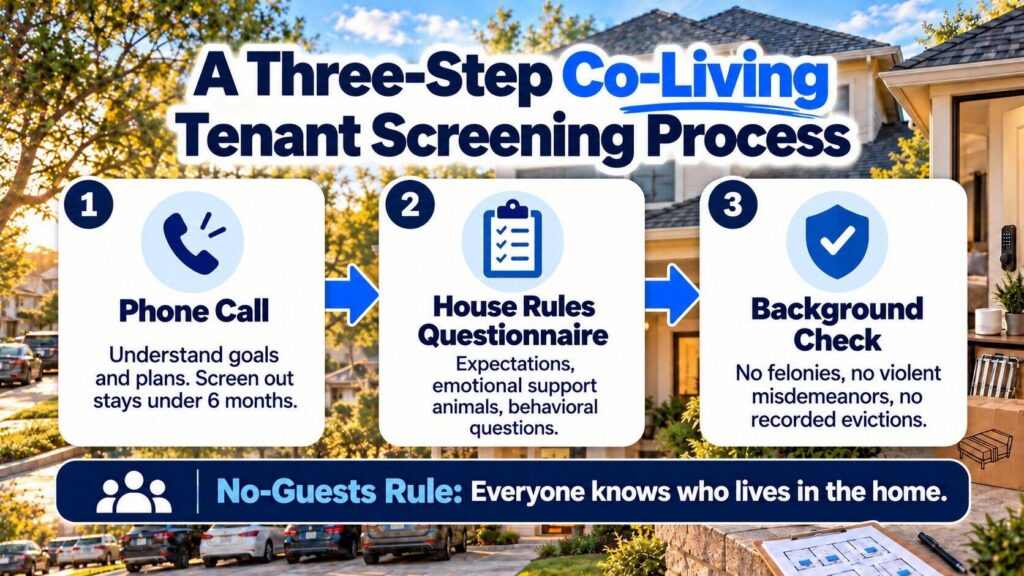
So David leans on screening instead of lease length. Tenants commit to an initial three months, then go week-to-week or every two weeks to match their pay schedule. He lists homes through a rent-by-the-room platform for marketing and basic management tools. Then he adds his own three-part process.
First comes a phone call to understand the applicant’s plans and catch inconsistencies. Second, a questionnaire covering house rules, expectations, and emotional support animals. Third, a separate background check. Felonies are a no. Violent misdemeanors are a no. Any recorded eviction is a no.
That extra layer matters. A federal report on tenant screening errors from the Consumer Financial Protection Bureau found that screening reports can contain inaccurate or outdated information. A real conversation with each applicant fills gaps a report can miss.
The no-guests rule ties it all together. As David put it, eight people share that home and expect to feel safe. Everyone should know who lives there.
Can Co-Living Help Close the Affordable Housing Gap in North Texas?
This was the most thought-provoking part of our talk for me, as someone who cares about how Wichita Falls grows. Who builds the housing that working people can actually afford?
“In a lot of cities, in a lot of states today, they’re starting to pass more and more co-living-friendly regulations. But you need to understand co-living is existing very much in a gray space today, same way Airbnb was when it first launched or when Uber first came into play. We’re waiting for rules, laws, and regulations to come and to catch up with the fact that affordable housing in a number of cities is desperately needed. The cities don’t want to spend money to build out the next projects, you know, build affordable housing. So independent investors coming in and filling that niche is really probably the best way, fastest way to get this done. But everyone should do their own research on occupancy and again, understand you’re playing in a gray space. There are tremendous rewards, but there are things you need to be aware of.” — David Edwards
I used to see co-living mainly as an investor play. Now I see it as a housing supply question too. It touches zoning, occupancy rules, and how cities plan for growth. Local leaders, investors, and agents should be talking about it together.
The returns explain why the conversation is heating up. David’s four homes cash flow just under $10,000 a month combined. As traditional rentals, a good month would bring in $500 to $600. He tells clients a well-run home should fund a vacation every quarter.
None of that works without discipline. Permits, realistic rents, strong screening, and real systems separate a profitable co-living investment strategy from an expensive lesson. If you’re buying your first investment property, it’s just as important to understand how much house you can really afford before you stretch for a bigger conversion.
To keep learning from David, connect with him professionally or join his free monthly session on the second Wednesday of each month. I share local market updates and conversations like this one on my Instagram and LinkedIn, and you can find more North Texas real estate resources on my website.
Want to hear the full story behind David Edwards of CoLiving Operations and his $2,000-a-month co-living model? Listen to our podcast episode!
Listen Here


Frequently Asked Questions About Co-Living Investing
What makes a property a good fit for co-living?
David looks first at parking, then at access to public transportation and a real local affordability gap. He also wants a floor plan with grouped common areas and room for about eight bedrooms.
How much more can co-living cash flow than a traditional rental?
In David’s experience, a house that cash flows about $100 a month as a single-family rental can produce around $2,000 a month as co-living. His four homes bring in just under $10,000 a month combined.
Do I need special insurance for a co-living property?
Often, yes. Standard landlord policies may not cover multiple tenants or variable stays. David carries coverage similar to a short-term rental policy, at about two and a half to three times the cost.
Who is Tim Lockhart, and why is he qualified to help?
Tim Lockhart is a retired U.S. Air Force Major and Certified Military Relocation Professional (MRP). His final assignment was Director of Operations at the 366th Training Squadron at Sheppard AFB. Since 2012, he has helped more than 300 families buy and sell around Wichita Falls, many of them PCSing in or out of Sheppard AFB. He uses VA loans, BAH-aware budgeting, and remote-friendly tools built for tight PCS timelines. See how Tim helps military families relocate to Wichita Falls.
Apply To Be a Guest on The Falls Home Front Podcast
Housing affordability is changing. Investors are rethinking how properties perform, and North Texas communities are growing in ways that call for new ideas.
If you’re solving real problems in real estate, whether in investing, property management, construction, lending, or community development, we’d love to hear your story.
Disclaimer: This content is for informational and entertainment purposes only. Tim Lockhart is a licensed REALTOR® in Texas. The co-living investment strategies and property management insights shared here do not constitute investment, legal, or financial advice. Listeners should consult appropriate licensed professionals for their specific situation.
About Tim Lockhart
Tim Lockhart is a Wichita Falls Sheppard AFB PCS Home Selling & Exit Strategy Specialist for military homeowners. He works with active duty personnel preparing for PCS moves to help them determine the right strategy for their home—whether to sell, hold, or adjust timing—before executing the plan. Tim is a REALTOR® with Keller Williams Wichita Falls and a RamseyTrusted real estate agent. He is a retired U.S. Air Force officer with over a decade of experience helping clients navigate complex, time-sensitive real estate decisions in Wichita Falls, Burkburnett, and Iowa Park. If you have PCS orders and need a clear plan for your home, schedule a consultation to map out your next step.- How a Pink-Stained Rental Disaster Led David Edwards of CoLiving Operations to a $2,000-a-Month Housing Model - October 20, 2026
- Why JC San Pedro of Amplify Credit Union Warns Buyers Not to Spend Their Full Pre-Approval - October 5, 2026
- What Is Really Happening in the Wichita Falls Housing Market This Fall? - October 2, 2026
- Why Smokey Garrett of The GO Network Believes AI Will Make Great Agents Impossible to Replace - September 28, 2026
- Why Did a Wichita Falls REALTOR® Step Up as a Founding KW Military Ambassador in Texas? - September 24, 2026
- Kelly Thompson of Shearman Roofing and Construction Explains Why the Best Roofers Slow Down First - September 22, 2026
- Lawrence Courtien of Buffalo Property Inspections on the Inspection Mistake That Costs Buyers Thousands - September 14, 2026
- Will Clark of Clark Design Studio Reveals the One Design Choice That Saves Wichita Falls Homeowners Thousands - September 8, 2026
- How Gaby Lockhart of Barrett Financial Group Turns a Lender’s No Into a Yes for Wichita Falls Buyers - September 3, 2026
- Should Military Families Hold Real Estate as an Investment Instead of Selling It? - August 27, 2026