

Should you shop at the top of your pre-approval? Usually not.
A pre-approval letter shows what a lender will lend, not what your household can comfortably carry once property taxes, homeowners insurance, and mortgage insurance land on top of principal and interest. In North Texas, where hail keeps pushing insurance renewals higher, that gap grows every year.
On this episode of The Falls Home Front, I sat down with JC San Pedro of Amplify Credit Union, a lender with nearly 29 years in the business, to pull back the curtain on how loan decisions really get made.
Curious how JC separates approved from affordable? Here’s a quick preview of our conversation:
What 29 Years Behind the Lending Desk Teaches You About Borrowers
Most buyers only see the finished product. The house. The payment. The stack of closing documents. Behind all of that sits a financial system most people never think about, and I wanted a lender’s view of it.
JC grew up in San Benito, down in the Rio Grande Valley. His mom worked in banking, and his dad taught high school, so he knew early he’d follow one of them. His first banking job was at Harlingen Teachers Credit Union, now RGB Credit Union. After college at the University of Texas-Pan American, he moved to Austin, worked at a credit union, then spent 12 years at a bank.
A little over eight years ago, he came back to the credit union world at a Texas credit union known for fee-free banking and member-first lending. Today he oversees commercial, consumer, and mortgage lending, and you can follow his nearly three-decade lending career as it keeps growing.
That track record is why his view matters. When you understand how a lender thinks, you walk into pre-approval with sharper questions. I cover the buyer side in my step-by-step guidance for buying a home in Wichita Falls. This conversation fills in the lender side.
Want the whole conversation? Watch the full episode here:
Why Credit Union Mortgage Lending Can Look at the Whole Borrower
Banks and credit unions both need to stay profitable. The difference is what that profit is for. JC explained that a credit union is a nonprofit cooperative with no shareholders. It answers to its members. The only way it raises capital is by earning it, and those earnings flow back to members and their communities. Federal regulators describe the same model when they explain how a credit union differs from a bank.
That structure shows up when a loan file gets complicated. Credit union mortgage lending often runs through a portfolio lender, which keeps some loans on its own books. JC said that lets his team look at the whole picture, connect with the borrower, and sometimes make a different call than a bank whose guidelines leave someone outside the box.
He was also honest that banking has become a commodity. A credit union can do nearly anything a bank can, and the reverse is true. So the real question becomes who you want sitting across the desk.
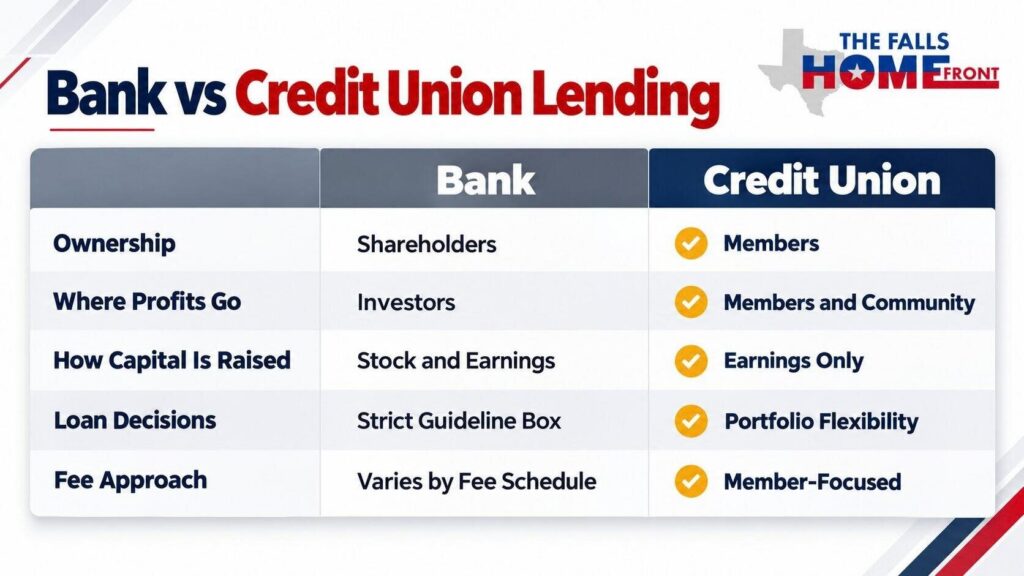
Here’s how I’d put that chart to work. If you’re a first-time buyer, talk to at least one bank and one credit union before you commit. Compare more than the rate. Ask how each one handles a file that doesn’t fit neatly. If you want help building that shortlist, reach out through my professional real estate network on LinkedIn.
One example from JC stuck with me. His team sometimes spots a dealership auto loan on a credit report with a payment that looks outrageous. Instead of ignoring it, they offer to refinance it too. A lower car payment makes the mortgage easier to carry. Amplify also offers fee-free checking and savings with no minimum balance, free wire transfers included. JC believes they may have been among the first in the country to go that far.
The Gap Between What You’re Approved For and What You Can Live With
Rates have bounced around this year. JC noted they sat lower seven or eight months ago and now run higher than this time last year. Home values are fairly flat nationally and down some in Texas, which helps a little. He also offered perspective. In the early 1980s, rates hit 15 or 16 percent.
Still, affordability is about more than the rate. Property taxes and homeowners insurance carry real weight in the monthly payment. That’s where the gap between mortgage pre-approval vs affordability opens up, and JC spends a lot of time helping members see it.
“I think that it’s sometimes a misconception by some borrowers not knowing that they can refinance down the road. But that shouldn’t be the only plan. When you’re pre-approved for a house, and I’m sure you experience this with your clients, they should really look for something in that range and not the high range, right? They don’t want to have to spend more on a monthly payment in hopes that they could refinance in a couple of years or in a couple of months, because that time may not come during the time that they’re in the house. And so that’s one thing that we spend a lot of time educating our members on, is just being mindful of what they can really afford despite what the max approved limit is.”
– JC San Pedro, Amplify Credit Union
I’ve lived this one. When I bought my first house, I was approved for far more than I felt comfortable paying. I didn’t even tell my agent the full number. I didn’t want to tour those homes and fall in love with one I couldn’t carry.
Here in North Texas, insurance makes that conversation even more urgent. Hailstorms and shifting weather have pushed annual renewals up. JC pointed out that nobody controls market rates, but homeowners can shop their insurance every year and protest their property taxes. Texas gives owners the right to challenge an appraised value before the local appraisal review board, and that can mean real savings.
Reserves came up, too. As a loan officer in the early 2000s, JC sometimes had to tell borrowers they weren’t quite ready. They didn’t have enough months of savings to take on new debt safely. His test is simple. Can you eat out less and travel less if the payment demands it?
Payment shock is real, whether it’s your first home or an investment property. Before you set a price range, check recent Wichita Falls home prices and market trends so your number reflects reality. JC also shares practical lending and homebuying conversations on his Facebook page.
The Hidden Monthly Charge Many First-Time Buyers Never Budget For
Private mortgage insurance usually kicks in when a buyer puts down less than 20 percent. I call it a hidden cost because so many buyers never see it coming. It can easily add a couple hundred dollars a month. Worse, private mortgage insurance costs often stick around longer than people expect.
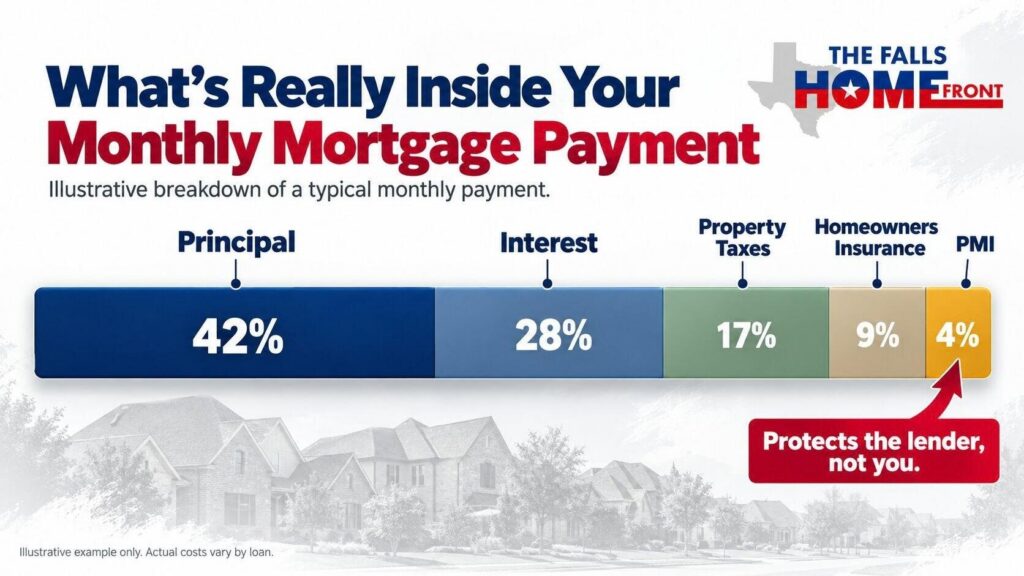
That breakdown makes a great gut check before you tour a single house. Every segment counts toward your payment. Only one of them does nothing for you, and JC didn’t sugarcoat it.
“Private mortgage insurance really protects the lender. In the event that the borrower is unable to make their payments, in the event that there’s a default and the lender has to foreclose on the house, the lender can then make a claim against that private mortgage insurance. And so it’s not a benefit to the borrower in any way. And to your point, in some cases it can be several hundred dollars a month that they have to pay until the loan reaches a certain loan-to-value limit, or in some cases it just never falls off.”
– JC San Pedro, Amplify Credit Union
There is a federal safeguard. Under the Homeowners Protection Act of 1998, many conventional borrowers can request PMI cancellation once their balance reaches 80 percent of the home’s original value. It must end automatically at 78 percent if payments are current. The CFPB explains when you can remove private mortgage insurance from your loan. FHA and VA loans follow different rules.
Amplify went after this problem directly. Last year it launched one of the more generous first-time homebuyer programs in Texas, offering 100 percent financing and no PMI for qualified borrowers. JC said they built it for members who were home-ready. They’d paid rent for years but couldn’t save tens of thousands for a down payment plus closing costs. You can see how it fits alongside their first-time homebuyer resources and loan options.
Doctor and professional loan programs follow the same 100 percent, no-MI structure. JC was candid about the risk. These loans don’t meet every guideline Fannie Mae, Freddie Mac, or the Federal Home Loan Bank of Dallas requires. That doesn’t make the borrower a bad credit risk. Some of his members compared FHA or VA options and picked this program just to skip the extra monthly cost.
Where Your Mortgage Actually Goes After Closing Day
This part surprises almost everyone. JC helped grow Amplify’s loan participation marketplace to roughly 150 investors. Most are other credit unions spread across 40 states.
Mortgage lending eats capital. To keep lending, a lender has to sell loans. Amplify sells many to Fannie Mae, Freddie Mac, and the Federal Home Loan Bank of Dallas. For loans those agencies won’t buy, it usually sells 90 percent to a participating investor and keeps 10 percent. Each month, Amplify passes along 90 percent of the principal and interest and keeps a servicing fee. The borrower still calls Amplify and stays a member.

Why should a buyer care? That freed-up capital keeps options open. JC said about 4,400 credit unions operate nationwide, and roughly 20 percent didn’t originate a single mortgage last year. Participations let those institutions earn income and spread their risk. Meanwhile, lenders like Amplify keep funding new loans.
Price is the big one. For 2026, the FHFA set the baseline conforming loan limit at $832,750 for most of the country. Above that, the agencies won’t buy the loan. Amplify’s investors will. That’s how JC’s team offers hybrid jumbo adjustable-rate mortgages, including $2 million to $5 million loans that come in through about 50 wholesale brokers.
The same network supports home equity loans and lines of credit for homeowners who want to add a pool or tap built-up equity. It also powers purchase money seconds. Say you have 10 percent down. A first loan covers 80 percent, a second lien covers the other 10, and the deal closes.
What Military Families Should Ask Before Leaning on a VA Loan
Near the end of our talk, JC thanked me for my service. He shared that his brother-in-law recently retired after serving in the Army and Coast Guard and flying 7,200 hours in helicopters. That meant a lot. It also led to advice every PCSing family should hear.
Many of my clients reach Sheppard Air Force Base on tight timelines, sometimes straight from an overseas assignment. VA loans for military relocation in Wichita Falls TX can be a huge help. They can also trip people up when nobody explains the details early.
“The VA program is a great benefit, and it’s something that y’all are entitled to for having served the country. And I think oftentimes borrowers can sometimes run into challenges when they’re working with a large bank, especially because there are just so many that are trying to go through this system, that I think it’s helpful to partner with a credit union or a local lender where you’ll be able to get that personal service, because especially if you’re in transition from moving from another country, another part of the world, that shouldn’t be another obstacle. And sometimes I hear stories from borrowers that they got to the loan processing stage and they were unaware of what they actually qualified for as it relates to the entitlement and what the funding fee was going to be.”
– JC San Pedro, Amplify Credit Union
JC cited a funding fee of about 2.15 percent, which lines up with the VA’s first-use rate when you put less than 5 percent down. Review the official VA funding fee rates and closing cost rules before you apply. Some veterans with service-connected disabilities don’t pay it at all.
My advice is simple. Confirm your entitlement and funding fee before you’re deep in processing. Ask about other programs and down payment assistance. Don’t lean on a commercial or a buddy’s story. Even with zero down, build your budget around your BAH and what you can comfortably carry.
Helping families through these moves is exactly why I stepped up to serve military families across Texas. I post PCS tips and local happenings through my Wichita Falls real estate updates on Instagram, too.
Why Owning a Home Still Builds Wealth Across North Texas Families
JC mentioned that Amplify has often noted in press releases that a homeowner’s generational wealth runs roughly ten times greater than a renter’s. I see why every week. Homes have historically appreciated around 4 percent a year, which steadily builds net worth. Ownership also brings stability. Kids grow up in one neighborhood and stay in the same schools.
The biggest misconception JC hears? That someone simply can’t afford a home. He pointed to how much people spend on rent over a lifetime. With the right loan structure and some discipline, many renters can save for a down payment and closing costs. Buying isn’t only for the ultra-rich.
He was fair about renting, too. If you move every one to three years, renting can make more sense. If you’ll stay a while, a home becomes a tangible asset. You can even keep it as a rental when you leave, which many of my military clients do.
He also eased a common worry. A property tax assessment isn’t a full appraisal, and the number that truly matters shows up when you sell. If you’re curious where yours stands, start with an instant estimate of your Wichita Falls home value. JC shares a lighter side of Texas life through his personal photo feed as well.
This conversation changed how I coach. I now ask buyers to bring their comfortable number to the lender, not just their maximum. My biggest takeaway from JC San Pedro of Amplify Credit Union is simple. The right loan starts with an honest budget.
Want to hear the full conversation with JC San Pedro, Chief Lending Officer at Amplify Credit Union, where we break down pre-approval versus true affordability, PMI, first-time buyer programs, and VA loan options for Wichita Falls families? Listen to the full podcast episode.
Listen Here


FAQ
Should I shop for homes at my full pre-approval amount?
Not necessarily. JC recommends shopping within your approved range rather than at the top. Taxes, insurance, PMI, and lifestyle costs all hit your monthly budget, and a future refinance is never guaranteed.
Who does private mortgage insurance actually protect?
The lender. PMI lets the lender file a claim if a borrower defaults. It can cost several hundred dollars a month and may last until you reach a set loan-to-value or, on some programs, for the life of the loan.
Can I buy a home in Texas with no down payment?
Some programs allow it for qualified borrowers. Amplify offers a first-time homebuyer program with 100 percent financing and no PMI, and eligible veterans can use VA loans. Each has its own requirements, so compare options with a lender.
What should veterans confirm before using a VA loan?
Confirm your entitlement and the funding fee early, before processing gets underway. Then ask whether another program or down payment assistance might fit your situation better.
What makes Tim Lockhart a trusted guide for military moves around Wichita Falls?
Since 2012, Tim has helped more than 300 families buy and sell around Wichita Falls, and many of them were PCSing in or out of Sheppard AFB. He brings that work and the discipline of a retired U.S. Air Force Major whose final assignment was Director of Operations at the 366th Training Squadron at Sheppard AFB. As a Certified Military Relocation Professional (MRP), he relies on VA loans, BAH-aware budgeting, and remote-friendly tools built for tight PCS timelines. See how Tim helps military families relocate to Wichita Falls
Apply as a Guest on The Falls Home Front Podcast
Every closing in Wichita Falls depends on people most buyers never meet. Lenders, investors, inspectors, and local leaders quietly shape how our community grows.
JC reminded me that good lending starts with understanding the person across the desk. That same spirit is what I look for in every guest who helps our neighbors make confident moves.
If you’re doing that work in North Texas and solving real problems for families, I want to hear your story on the show.
Disclaimer: This content is for informational and entertainment purposes only. Tim Lockhart is a licensed REALTOR® in Texas. Mortgage, lending, and loan program insights shared here do not constitute financial, lending, or tax advice. Please consult a licensed lender, financial advisor, or tax professional about your specific situation.
About Tim Lockhart
Tim Lockhart is a Wichita Falls Sheppard AFB PCS Home Selling & Exit Strategy Specialist for military homeowners. He works with active duty personnel preparing for PCS moves to help them determine the right strategy for their home—whether to sell, hold, or adjust timing—before executing the plan. Tim is a REALTOR® with Keller Williams Wichita Falls and a RamseyTrusted real estate agent. He is a retired U.S. Air Force officer with over a decade of experience helping clients navigate complex, time-sensitive real estate decisions in Wichita Falls, Burkburnett, and Iowa Park. If you have PCS orders and need a clear plan for your home, schedule a consultation to map out your next step.- Why JC San Pedro of Amplify Credit Union Warns Buyers Not to Spend Their Full Pre-Approval - October 5, 2026
- What Is Really Happening in the Wichita Falls Housing Market This Fall? - October 2, 2026
- Why Smokey Garrett of The GO Network Believes AI Will Make Great Agents Impossible to Replace - September 28, 2026
- Why Did a Wichita Falls REALTOR® Step Up as a Founding KW Military Ambassador in Texas? - September 24, 2026
- Kelly Thompson of Shearman Roofing and Construction Explains Why the Best Roofers Slow Down First - September 22, 2026
- Lawrence Courtien of Buffalo Property Inspections on the Inspection Mistake That Costs Buyers Thousands - September 14, 2026
- Will Clark of Clark Design Studio Reveals the One Design Choice That Saves Wichita Falls Homeowners Thousands - September 8, 2026
- How Gaby Lockhart of Barrett Financial Group Turns a Lender’s No Into a Yes for Wichita Falls Buyers - September 3, 2026
- Should Military Families Hold Real Estate as an Investment Instead of Selling It? - August 27, 2026
- What Ian McMurtrie and Rita Beemen of Raconteur Press Taught Me About Owning Your Own Story - August 26, 2026