
What Is Really Happening in the Wichita Falls Housing Market This Fall?
By Tim Lockhart, REALTOR®, Lockhart Real Estate Team, Keller Williams Realty. Retired Air Force Civil Engineering Officer, Military Relocation Professional (MRP), and RamseyTrusted agent serving Wichita Falls, Sheppard Air Force Base, Burkburnett, and Iowa Park since 2012.
The Wichita Falls housing market is shifting toward buyers, even though the latest official numbers still look fairly healthy. The August 2026 report from the Wichita Falls Association of REALTORS® (WFAR) shows fewer listings, faster sales, and a higher median price. What I see walking through listings every week tells a more cautious story.
Showings on active listings have dropped off in recent weeks. Buyers are taking their time. They tour a home, go home, think about it, and often tour three more before they write anything. That doesn’t mean the numbers are wrong. It means they measure something different from what I’m feeling on the ground, and sellers need to understand both before they set a price.
Here’s my read on the data, where it falls short, and what it means if you own a home in Wichita County right now.
What Do the August 2026 WFAR Numbers Show for Wichita Falls?
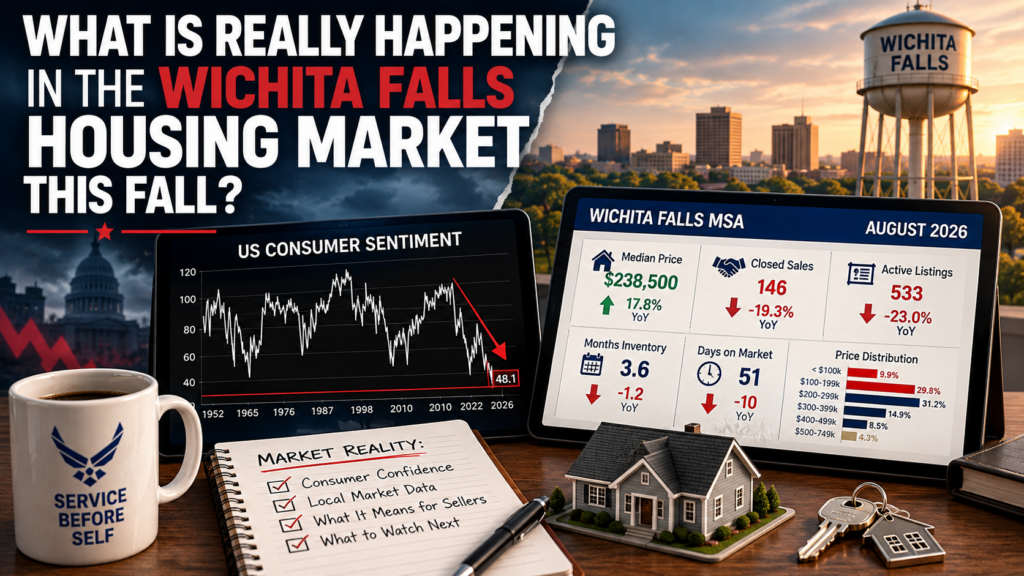
In August 2026, the Wichita Falls metro area recorded 146 closed sales at a median price of $238,500, with 533 active listings and 3.6 months of inventory. On paper, that still leans slightly toward sellers. Sales volume, though, fell almost 20% from a year earlier.
These figures cover the Wichita Falls Metropolitan Statistical Area, which includes Wichita, Archer, and Clay counties. They come from the Texas REALTORS® Data Relevance Project, with analysis by the Texas Real Estate Research Center at Texas A&M.
| Measure (August 2026) | Result | Change from August 2025 |
|---|---|---|
| Median sale price | $238,500 | Up 17.8% |
| Median price per square foot | $135.69 | Up 5.8% |
| Closed sales | 146 | Down 19.3% |
| Active listings | 533 | Down 23.0% |
| Months of inventory | 3.6 | Down 1.2 months |
| Days on market | 51 | Down 10 days |
| Days to close | 33 | Up 2 days |
| Total days, list to close | 84 | Down 8 days |
| Sale price vs. original list price | 96.4% | Not reported |
A few plain-English definitions help here. Months of inventory is how long it would take to sell every home currently listed if nothing new came on the market. Days on market is how long a home sits before it goes under contract. Sale price vs. original list price tells you the typical seller closed about 3.6% below where they first priced the home.
The price mix matters too. About 61% of August sales landed between $100,000 and $299,999, and only about 6% sold above $500,000. Wichita Falls is still a market built on the middle.
Why Does the Wichita Falls Market Feel Slower Than the Numbers Suggest?
Closed sales are a rearview mirror. A home that closed in August usually went under contract in late June or July, so the August report mostly describes buyer behavior from early summer. Showings tell you what buyers are doing this week.
With 33 days from contract to closing, the math is simple. The softer showing traffic I’ve seen since late summer hasn’t had time to show up in closed sales yet. If fewer buyers are walking through homes in September and October, fewer homes will close in October and November.
You can already see a hint of this on the WFAR growth chart. Closed sales growth climbed above zero in 2025, ran up through spring 2026, and then turned back down in the most recent months. One month isn’t a trend. Combined with what agents are seeing at the front door, though, it’s worth taking seriously.
The 19.3% drop in closed sales is the number I’d pay the most attention to. Fewer listings normally means fewer sales. But when sales fall nearly as fast as inventory, it tells me demand is thinning out right along with supply.
Did Wichita Falls Home Values Really Jump 17.8% in a Year?
Not really. The 17.8% jump in median sale price most likely reflects which homes sold in August, not a sudden rise in what every home is worth. Median price per square foot rose 5.8%, which is a more reliable read on actual value change.
A median is just the middle sale in the pile. With only 146 sales in a month, a handful of larger or newer homes closing, or fewer entry-level homes closing, can move that middle number a lot. That’s a mix shift, and it happens in small markets all the time.
The close-to-list number backs this up. Sellers closed at 96.4% of their original list price on average. In a market where values were truly running up nearly 18%, you’d expect sellers getting full price or more, not trimming about $8,600 off a $238,500 home.
My advice to homeowners is to treat the 5.8% figure as the closer estimate and to ask for a pricing analysis built on recent sales in your own neighborhood. Fountain Park, Tanglewood, Burkburnett, and Iowa Park don’t all move together.
If Active Listings Are Down, Why Do Buyers Have More Homes to Choose From?
Because “down 23%” is measured against August 2025, which was one of the highest inventory points Wichita Falls has seen in a decade. Compared with the 2021 and 2022 market most buyers remember, today’s 533 active listings is still more than double.
Working backward from the WFAR figures, August 2025 had roughly 690 active listings. That was the peak of a two-year build-up. Back in 2021 and early 2022, active listings dipped to somewhere around 150 to 250 according to the WFAR chart. Buyers then were writing offers the same day they toured, often over asking, because there was nothing else to look at.
So both things are true at once:
- Inventory is lower than last year’s unusually high peak.
- Inventory is far higher than the frenzy years, especially in the $200,000 to $299,999 range where nearly a third of all sales happen.
There’s a second piece buyers feel even if they can’t name it. Choice isn’t just about how many homes are listed. It’s about how many other buyers are competing for them. With closed sales down 19.3%, there are fewer buyers chasing each listing. A buyer touring a $240,000 home in Tanglewood or near Sheppard AFB today rarely worries that someone else will grab it by tomorrow. That loss of urgency is real, and no inventory chart captures it.
At 3.6 months of supply, Wichita Falls is still below the roughly six months often used as a benchmark for a balanced market. The data says “slight seller’s edge.” Buyer behavior says “balanced, maybe tilting toward buyers.” I trust the behavior as the earlier signal.
Why Are Fewer People Buying Homes in Wichita Falls Right Now?
The biggest group missing from today’s market is the discretionary mover. These are homeowners who locked in a mortgage rate below 5% and don’t have to move. With rates now above 7%, most of them are staying put.
That choice removes two transactions, not one. When a family in Fountain Park decides not to sell, they also don’t buy their next home. That’s one less listing and one less buyer in the same move.
The payment gap explains why. Here’s an example on a $200,000 loan over 30 years, principal and interest only:
| Interest rate | Monthly principal and interest |
|---|---|
| 4.50% | About $1,013 |
| 7.25% | About $1,364 |
That’s roughly $350 more every month for the same loan amount, before taxes and insurance. For a family that likes their home well enough, trading up just doesn’t pencil out.
Who is still buying? Mostly people who have to move. Military families with PCS orders to Sheppard AFB, job relocators, people downsizing for health or family reasons, and first-time buyers ready to stop renting. That’s a steadier but smaller pool. For military buyers in particular, the move date isn’t optional, which makes Sheppard-area demand more dependable than demand in many other markets.
How Is Low Consumer Confidence Affecting Wichita Falls Home Buyers?
Buyers who feel uneasy about the economy slow down, compare more homes, and negotiate harder. The University of Michigan Consumer Sentiment Index recently read 48.1, among the lowest readings since the survey began in 1952. That mood is showing up in how local buyers shop.
Here’s what I’m seeing from buyers across Wichita Falls this fall:
- They want second and third showings before they commit.
- They feel no pressure to write an offer the first weekend.
- They ask for repairs, closing cost help, or price reductions after inspection more often than they did two years ago.
- They walk away from homes that need work unless the price already reflects it.
None of this means buyers have disappeared. It means the buyers who are out there expect the home to be ready and priced right on day one. A listing that would have sold in a weekend in 2022 can sit for six weeks now if it’s priced on last spring’s optimism.
What Should Wichita Falls Home Sellers Do in a Shifting Market?
Price for today’s buyer, not last year’s headlines, and have the home ready before the first showing. In this market, the first two weeks of a listing do most of the work. A home that misses that window often ends up selling for less after one or two price cuts.
Here’s the game plan I walk sellers through right now:
- Price from recent neighborhood sales, not the metro median. A 17.8% jump in the area median doesn’t mean your home gained 17.8%. Price per square foot in your part of town is a better guide.
- Fix what buyers will flag at inspection. Today’s buyers use the inspection report as a negotiating tool. Handling roof, HVAC, and foundation questions up front protects your price later.
- Plan on about 84 days from listing to closing. That’s the August average. Give yourself room beyond that, especially if you’re timing a move.
- Know your options before you list. Some sellers need top dollar, some need speed, and some need certainty. A traditional listing, a pre-inspected listing, offering a rate buydown to buyers, or renting the home out can each make sense depending on your goals.
What Should Military Families With PCS Orders From Sheppard AFB Do?
Start planning as soon as you have orders, ideally 90 to 120 days before your report date. With 84 total days from listing to closing, a family that waits until 60 days out is already behind.
My family made multiple PCS moves, including two while I was deployed, and we sold our own home on orders. I know how fast that calendar fills up. If you’re weighing whether to sell or keep the home as a rental, run the numbers on both. A tax professional and a financial advisor should weigh in on that decision, since rental income, depreciation, and capital gains rules all affect your outcome.
Is Fall 2026 a Good Time to Buy a Home in Wichita Falls?
For buyers who need to move, this is the most room to negotiate Wichita Falls has offered in several years. Rates are higher, but competition is lighter and sellers are more willing to talk about price, repairs, and closing costs.
That doesn’t mean every listing is a bargain. Well-prepared, well-priced homes in the $200,000 to $299,999 range still draw serious interest. The opportunity shows up mostly in homes that have been sitting 45 days or more, or that need some updating.
Buyers relocating to Sheppard AFB have one more thing working for them. Sellers today are more open to flexible closing dates and concessions, which helps when your report date and your household goods shipment don’t line up neatly. Talk with a lender about how a seller-paid rate buydown might lower your payment, since that can be worth more than a price cut.
What Are the Most Common Questions About the Wichita Falls Housing Market Right Now?
Is Wichita Falls a buyer’s market or a seller’s market?
It sits in between. With 3.6 months of inventory in August 2026, the official data still gives sellers a slight edge. Buyer behavior on the ground feels more balanced, with less urgency and more negotiation than the numbers alone suggest. This points to a shifting market.
Are home prices dropping in Wichita Falls?
Not on average. Median price per square foot rose 5.8% from August 2025 to August 2026. Individual sellers are negotiating more, though, and the typical home closed at 96.4% of its original list price.
How long does it take to sell a house in Wichita Falls?
About 84 days from listing to closing, based on August 2026 data. That includes an average of 51 days on market and 33 days from contract to closing. Homes that are priced right and ready to show often move faster.
Should I wait for interest rates to drop before selling my Wichita Falls home?
That depends on whether you need to move and what you’d do next. Nobody can reliably predict where rates will go. If you have orders, a job change, or a life event driving the move, waiting often costs more than it saves. A conversation with your lender and financial advisor is the right place to weigh it. Most experts are advising there are not signs to significant rate decreases in the near future.
Why did the Wichita Falls median price go up 17.8%?
Mostly because of which homes sold, not a market-wide jump in value. With 146 sales in August, a shift toward larger or newer homes can move the median sharply. Price per square foot, up 5.8%, is the better measure of value change.
What Is the Bottom Line for Wichita Falls Homeowners?
The Wichita Falls market isn’t crashing, but it has changed, and is entering a shift. Inventory is still well above the frenzy years, buyers are fewer and more careful, and sellers who price on old assumptions are the ones sitting longest.
The homeowners doing well this fall are the ones who start with a plan. They know their numbers, prepare the house before it hits the market, and pick a selling strategy that fits their timeline instead of copying what worked in 2022.
If you’re thinking about selling in Wichita Falls, Burkburnett, Iowa Park, or anywhere around Sheppard AFB, let’s sit down for a Seller Strategy Consultation. I’ll walk you through what homes like yours are actually selling for and lay out your options, with no pressure either way.
Tim Lockhart, REALTOR® | Lockhart Real Estate Team | Keller Williams Realty Options. Strategy. Results.
Sources: Wichita Falls Association of REALTORS®, August 2026 Statistics for the Wichita Falls MSA, from the Texas REALTORS® Data Relevance Project with analysis by the Texas Real Estate Research Center at Texas A&M University. University of Michigan Surveys of Consumers, Index of Consumer Sentiment (latest reading 48.1). Payment examples are illustrative estimates of principal and interest only and are not a loan quote. This article is general market information, not tax, legal, or financial advice. Please consult a licensed professional about your specific situation.
- What Is Really Happening in the Wichita Falls Housing Market This Fall? - October 2, 2026
- Why Smokey Garrett of The GO Network Believes AI Will Make Great Agents Impossible to Replace - September 28, 2026
- Why Did a Wichita Falls REALTOR® Step Up as a Founding KW Military Ambassador in Texas? - September 24, 2026
- Kelly Thompson of Shearman Roofing and Construction Explains Why the Best Roofers Slow Down First - September 22, 2026
- Lawrence Courtien of Buffalo Property Inspections on the Inspection Mistake That Costs Buyers Thousands - September 14, 2026
- Will Clark of Clark Design Studio Reveals the One Design Choice That Saves Wichita Falls Homeowners Thousands - September 8, 2026
- How Gaby Lockhart of Barrett Financial Group Turns a Lender’s No Into a Yes for Wichita Falls Buyers - September 3, 2026
- Should Military Families Hold Real Estate as an Investment Instead of Selling It? - August 27, 2026
- What Ian McMurtrie and Rita Beemen of Raconteur Press Taught Me About Owning Your Own Story - August 26, 2026
- Is a VA Loan Really Weaker Than a Conventional Offer for Wichita Falls Sellers? - August 24, 2026