
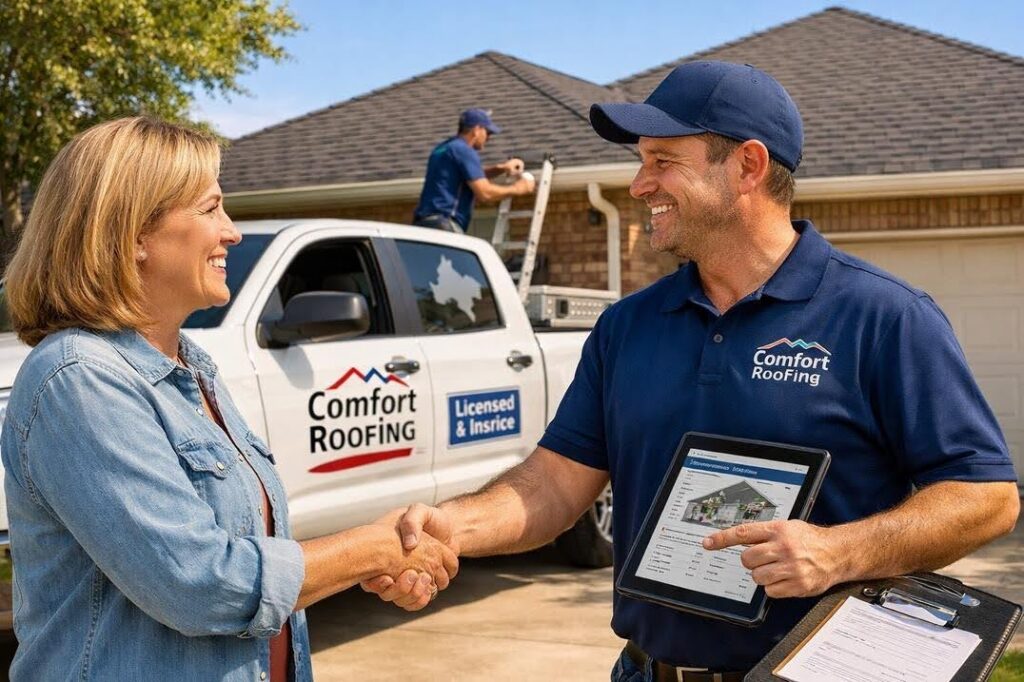
Brian Barnes and Mark Weeks from Comfort Roofing stand outside a Wichita Falls, Texas home, with a roofing truck and ladder in the background.
Storm damage is a reality for homeowners in Wichita Falls and across North Texas. When the wind picks up and the hail starts falling, the aftermath can feel overwhelming.
That’s why I recently sat down with Brian Barnes & Mark Weeks of Comfort Roofing Wichita Falls, on The Falls Home Front podcast. We talked about what every homeowner needs to know about protecting their property, navigating insurance claims, and avoiding the pitfalls that come with severe weather.
You can listen to the full episode, but here are the biggest takeaways from our conversation. This is designed to help you, whether you’re dealing with damage right now or just want to be prepared for the next storm.
Why I Had This Conversation
As a REALTOR® serving Wichita Falls and North Texas, I’ve seen how confusing the aftermath of a storm can be. Homeowners are often overwhelmed by the damage, unsure of how to deal with their insurance, and vulnerable to contractors who show up from out of town. Whether you’re buying or selling a home in Wichita Falls, understanding storm damage and insurance is critical to protecting your investment.
That’s why I invited Brian and Mark onto the show. They aren’t just roofers; they’re former insurance adjusters who’ve been in the industry since 2005. Brian has also been a licensed public adjuster since 2015. They bring a rare combination of construction expertise and insurance knowledge. You can learn more about their background and services at Comfort Roofing. What makes them truly different, though, is that they are local. Both were born and raised here, graduated from local schools, and have their families in Wichita Falls.
If you ever need storm damage roof repair in Wichita Falls, having a local team that understands both construction and insurance is invaluable.
How the Insurance Industry Has Changed
One of the most eye-opening parts of my conversation was learning how much the insurance landscape has shifted over the past 15 to 20 years. The loyalty that once existed between insurance companies and long-term customers has essentially disappeared.
Brian explained that even 15 years ago, a local insurance agent could call an adjuster directly and advocate for a customer. Common-sense decisions could be made. Today, that personal touch is gone. Whether you’ve been with a company for 50 years or two days, the treatment is often the same. For help understanding your policy, the Texas Department of Insurance consumer guides offer valuable resources.
"The loyalty is passed by the insurance industry. The long-term customer that the agent may have had... even 15 years ago, that agent could call, talk to somebody personally, and the adjuster could actually make some common sense decisions to help out. And I think a lot of that has since passed by."
- Brian Barnes
Worse, policies change annually, but homeowners rarely know about it. You might file a claim thinking something is covered, only to find out your policy changed and you were never notified. Brian put it plainly: most homeowners don’t even have a certified copy of their policy. They get a brief description, not the full contract.
Another major shift is the rise of “inspectors” instead of traditional adjusters. Now, someone comes out, takes photos, and sends them to a desk adjuster who makes decisions based on images alone. As Brian noted, photos don’t capture everything, and that leads to damage being underestimated or misinterpreted in the final estimate.
What to Do Immediately After a Storm
If a storm hits, your first steps are critical. Documentation is your first line of defense.
"Take pictures. The most important thing is to take pictures—even a video while it's hailing if they can. Get pictures of your front yard with hail in it if possible. Once it's safe and clear and the storm has passed, just get outside, take a couple of pictures of the outside of your house in case there's a broken window."
- Brian Barnes
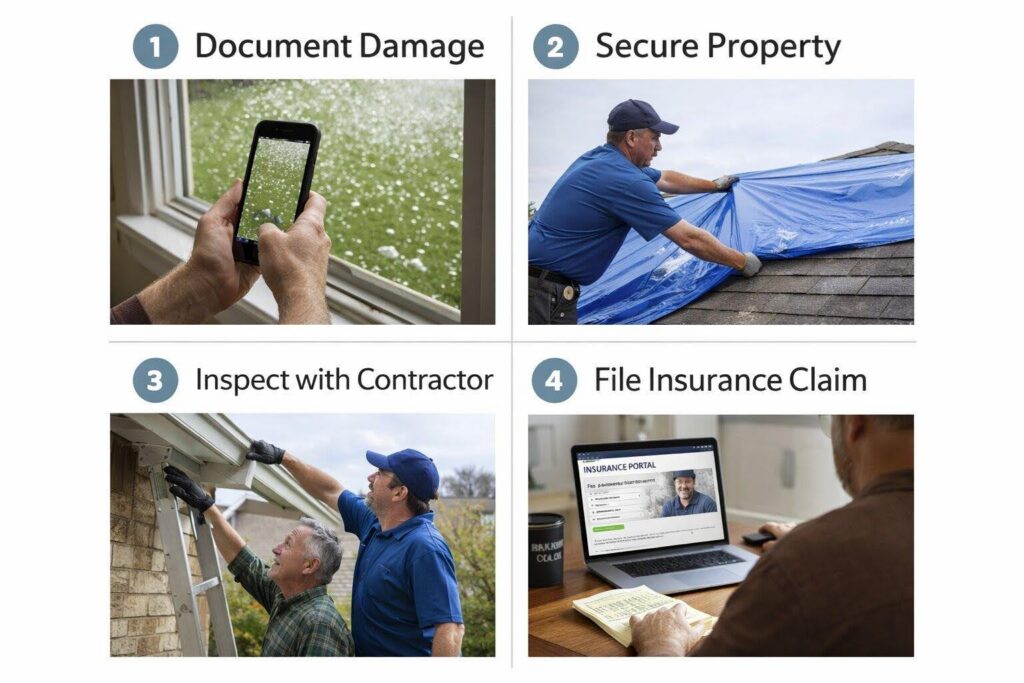
Before you call anyone, grab your phone and capture everything you can. If you need storm damage roof repair in Wichita Falls, a local professional can assess whether repairs or a full replacement are necessary. Once the storm passes, follow this order:
- Take photos and video during and after the storm.
- Secure your property by covering leaks or broken windows.
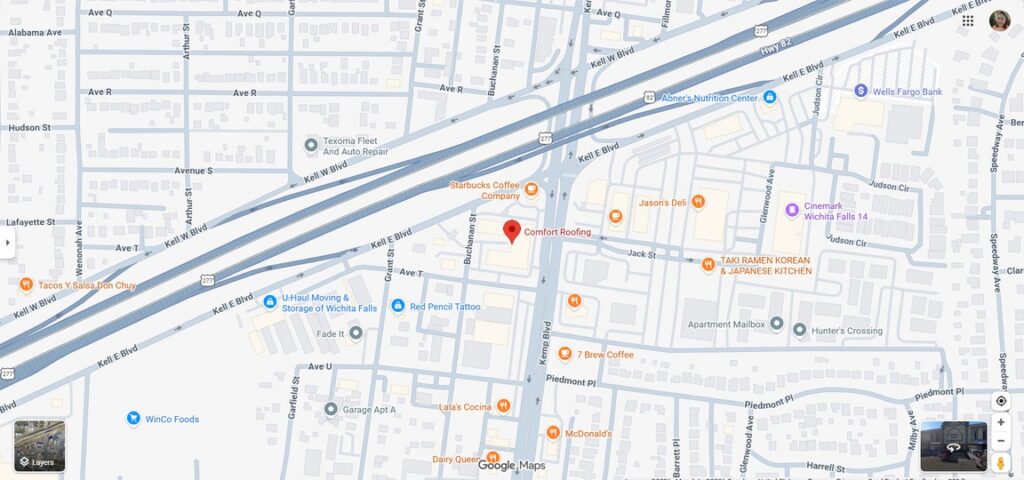
- Call a local contractor to inspect for damage. You can schedule a free roof inspection with Comfort Roofing to assess your property. You can reach them at 940-990-5055 or visit 2900 Kemp Boulevard, Unit 214, Wichita Falls, TX 76308.
- Only then will you contact your insurance company to file a claim.
One important caveat: have a professional confirm you actually have damage before filing a claim. You don’t want a claim on your record unless it’s legitimate.
Signs of Storm Damage You Might Miss
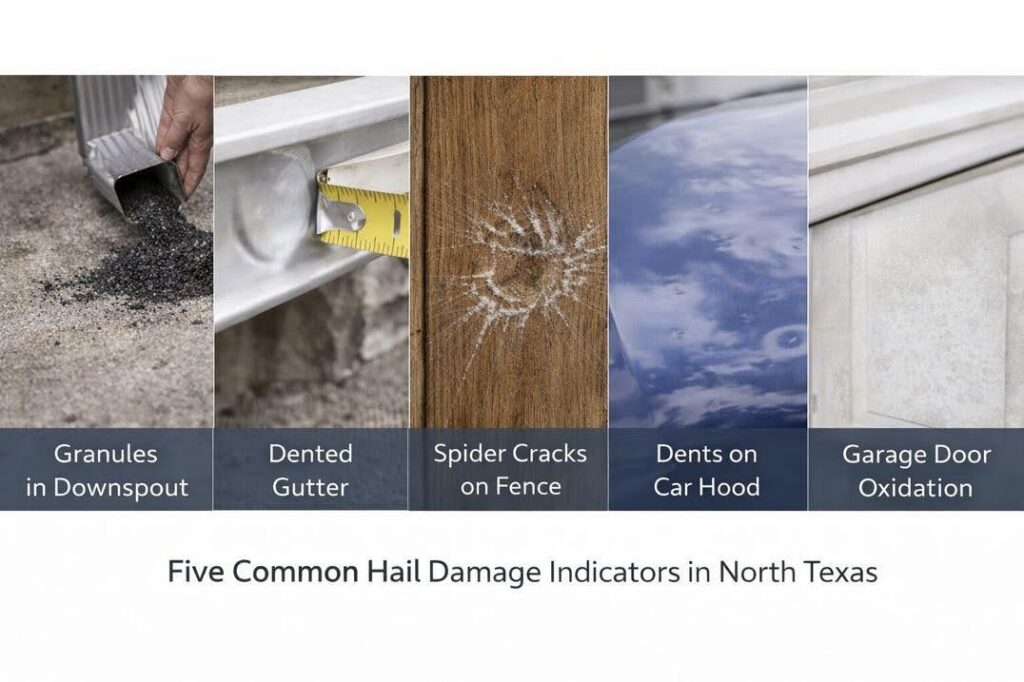
Hail damage isn’t always obvious from the ground. According to the National Weather Service storm reports for North Texas, hail size and composition vary widely, and each storm leaves unique damage patterns. Brian and Mark shared some telltale signs to look for:
- Granules in your downspouts – This is a clear indicator of shingle damage.
- Leaves knocked off trees – A sign of significant hail impact.
- Dents in gutters and downspouts – Metal surfaces show impact clearly.
- Spider marks on fences – Hail leaves distinctive patterns on wood.
- Marks on car hoods and garage doors – If your car has dents, your roof likely does too.
Brian shared an interesting detail: hail contains ammonia, which knocks oxidation off surfaces like white garage doors. That oxidation pattern can help determine the size of hail that hit your property. The color of the hail matters too. Milky-looking hail is softer and causes less damage. Clear hail is harder and more destructive.
The Hidden Danger of Waiting Too Long
Timing matters more than most homeowners realize. Damage shows up best on a shingled roof within a week or two after the storm, once granules have had time to release. But the longer you wait, the worse things get.
"If you've got some pretty good-sized hail—golf ball, a little bit bigger—and you go a year with that sun in the summer heat of Texas beating down on it, it's going to deteriorate that shingle to the point where you're going to start seeing leaks. You may not see them in your house, but the decking, the wood underneath your shingle, is now getting wet."
- Brian Barnes
Texas sun is brutal. Exposed matting on damaged shingles deteriorates quickly, and every time your decking gets wet, you’re moving closer to structural damage. The impacts themselves also fade over time. What clearly looks like hail damage at first can appear to be normal granule loss after a year.
Every insurance policy has limitations. Some give you 180 days to file, others 365 days. If things go badly, you generally have two years to file suit. But waiting means your evidence disappears, your damage worsens, and your claim becomes harder to prove.
Understanding the Texas roofing insurance claims process can help you avoid these common pitfalls.
Why You Should Have a Contractor Present During the Inspection
When the insurance adjuster comes out, Brian and Mark always recommend having a knowledgeable contractor there as a second set of eyes and ears. They’re not there to tell the adjuster how to do their job. They’re there to point out damage that might get missed.
A contractor can walk alongside the adjuster and notice things like a dented garage door, damaged window screens, or areas of the roof the adjuster might overlook. They can also ensure the scope of work in the final estimate aligns with the actual damage on the property.
The keyword here is “knowledgeable.” Not every contractor understands the Texas roofing insurance claims process. A good one knows what they can and cannot discuss. They can argue damages and scope of work, but they can’t get into policy details or deductibles.
When the homeowner receives that estimate, which often looks like what Brian jokingly called “Chinese arithmetic,” a good contractor can sit down with them, go line by line, and explain what everything means.
The Deductible Trap That Could Cost You Everything
This was one of the most important warnings from Brian and Mark. There are contractors in every city who will offer to “cover” your deductible. It sounds like a deal, but it’s actually a trap.
"If the contractor cannot afford to go get your materials, at least deliver them; you're okay to pay for half of it once your materials are delivered. Being an adjuster and working after hurricanes and stuff, there are contractors who will run off with your money, and it's gone. So be careful of how you pay your contractor."
- Brian Barnes
Here’s why covering a deductible is a bad idea:
- It’s illegal in Texas. Texas Legislature Online – House Bill 2102, effective September 1, 2019, made it a felony to waive a homeowner’s deductible.
- That money comes from somewhere. If a contractor is absorbing $3,000 or $5,000 of your deductible, they’re cutting corners on materials or workmanship.
- It’s insurance fraud. The contractor submits a false invoice to collect the full payment while not doing the full work.
Brian’s perspective helped me understand this: if your roof costs $10,000 and your deductible is $3,000, you’re getting $10,000 worth of work for $3,000. That’s the real value. Never pay a contractor up front. The safest approach is to pay half once materials are delivered, then the remainder after the work is completed.
How to Spot a Storm Chaser Before It’s Too Late
After every major storm, out-of-town contractors descend on affected areas. But when you’re searching for a reliable hail damage roofing contractor in North Texas, local expertise matters. Brian and Mark shared some simple ways to identify who’s actually local.
- Ask where they went to school. A Wichita Falls native will know the local schools.
- Ask where they live. If they can’t answer, that’s a problem.
- Check the license plates. Oklahoma tags with an Oklahoma City phone number? They’re not from here.
- Read the truck. “We serve San Antonio”, written on the side, tells you everything.
With today’s weather reporting technology, contractors know within 30 seconds of hail hitting the ground exactly where it landed. They’re literally chasing storms. The problem? Twelve months later, when you have an issue, they’re not driving back to help you.
Local contractors have a stake in the community. They’ll be here next year and the year after. That accountability matters. Supporting local businesses in Wichita Falls strengthens our community and ensures you have trusted professionals to call when you need them most.
Class 3 vs. Class 4 Shingles
Most roofs in today’s market use either Class 3 or Class 4 shingles. These classifications refer to hail and impact resistance. If you’re considering an upgrade, ask your agent about Class 4 impact resistant shingles in Texas, as many insurers offer premium discounts for them.
- Class 3 (Architectural/Laminated): This is the standard for most modern roofs. It’s a significant upgrade from the old three-tab shingles.
- Class 4 (Impact Resistant): These are heavier, thicker shingles with advanced technology. Some include fiberglass or bitumen backing for added durability.
If you’re considering an upgrade, ask your agent about Class 4 impact-resistant shingles, as many insurers offer premium discounts for them. The upfront investment in upgraded shingles can often be recovered through insurance savings over time.
In North Texas, Brian noted that while shingles are technically rated for 20 to 30 years, the typical lifespan of a roof is closer to 10 to 13 years because weather events almost always take out a roof before it naturally wears out.
What Changed for Me After This Conversation
Before this conversation, I understood the basics of what homeowners should do after a storm. But hearing Brian and Mark explain the insurance side—how adjusters are now often just inspectors, how policies change without notice, how long-term customer loyalty means nothing anymore—completely shifted my perspective.
As a REALTOR®, I now see how critical it is to connect my clients with local professionals who understand both construction and insurance. For up-to-date market insights for North Texas homeowners, I regularly share what I learn from conversations like this one. It’s not enough to just have your roof fixed. You need someone who can ensure the scope of work matches the damage, who can translate that estimate into plain English, and who will be here in Wichita Falls if something goes wrong down the road.
I also have a new appreciation for the deductible conversation. It’s not about saving money—it’s about getting the full value of the work you’re entitled to. When someone offers to “cover” your deductible, they’re really offering to shortchange your roof.
If there’s one thing I want every homeowner to take away from this episode, it’s this: document everything, call a local professional first, and never prioritize short-term savings over long-term protection. To stay connected with community events and local spotlights, I invite you to follow along for more conversations like this one.
Want to hear my entire conversation with Brian Barnes and Mark Weeks from Comfort Roofing? We talk about storm damage, insurance claims, and home protection with a reliable local contractor. Tune in to our podcast episode!
Listen Here


Frequently Asked Questions
How soon after a storm s:ould I file an insurance claim?
The sooner the better, but have a professional inspect your property first to confirm you have actual damage. Every policy has different time limits—some 180 days, some 365 days—so check with your agent. Waiting too long allows damage to worsen and evidence to fade.
Is it illegal to have my deductible waived in Texas?
Yes. As of September 1, 2019, Texas House Bill 2102 made it illegal for contractors to waive or pay a homeowner’s deductible. Any contractor offering to cover your deductible is committing insurance fraud and asking you to participate in it.
What’s the difference between a Class 3 and a Class 4 shingle?
Class 4 shingles are thicker, heavier, and more impact-resistant than Class 3. They often include fiberglass or bitumen backing. Many insurance companies offer premium discounts for Class 4 shingles, making the investment worthwhile over time.
What is a public adjuster, and do I need one?
A public adjuster roofing Wichita Falls professional works for you, the homeowner, not the insurance company. As Brian is licensed as one, he can help you understand your policy’s fine print, a service that’s invaluable when you don’t have a certified copy of your own policy.
Apply to Be a Guest on The Falls Home Front Podcast
Real estate, business, and community—these are the pillars of what makes Wichita Falls and North Texas a great place to live and work. If you’re a local professional, entrepreneur, or community leader with insights to share, I’d love to have you on the show.
Whether you’re in construction, finance, real estate, or any industry that touches homeowners’ lives, your story matters.
*This podcast is produced by the Icons of Real Estate – #1 Real Estate Podcast Network. For more resources on growing your show or refining your message, explore the podcast framework and read success stories from other industry professionals who have leveraged this platform, or apply to be a guest.*
About Tim Lockhart
Tim Lockhart, REALTOR®, is a RamseyTrusted real estate agent and retired U.S. Air Force Major serving Wichita Falls, Iowa Park, and Burkburnett, TX. Since becoming licensed in 2012, Tim has closed over 300 transactions, specializing in military relocation, listings, farm & ranch, and investment properties. He leads the Lockhart Real Estate Team at Keller Williams Realty and ranks among the top 10% of Keller Williams Lonestar DFW agents. Tim holds the MRP designation and has 45+ 5-star reviews across Zillow, FastExpert, and Google.- Brian Barnes & Mark Weeks on Storm Damage Claims | Comfort Roofing Wichita Falls - April 9, 2026
- Is the Wichita Falls, TX Housing Market Going to Crash in 2026? - March 26, 2026
- Wichita Falls Housing Market Update – February 2026: Prices Are Up, But Here’s What That Really Means - March 23, 2026
- Where to Hunt Easter Eggs in Wichita Falls in 2026 - March 12, 2026
- Lake Wellington Estates | Growth & Development - March 6, 2026
- Jim Bousquet & Red River Dart Leagues Texas - March 4, 2026
- Homes for Sale in Wichita Falls TX | Prices & Guide - February 25, 2026
- Subject 2 Real Estate: Strategy, Risks & Execution - February 18, 2026
- Photo Booth Rental Wichita Falls, TX for Meaningful Events - February 11, 2026
- What Are the Steps to Buying Your First House in the Wichita Falls TX Real Estate Market? - February 5, 2026